
Visiting Rouen? Don’t miss the Musée de la Céramique! This remarkable cultural institution opens the doors to an exceptional heritage. It houses France’s largest public collection of Rouen earthenware dating from the 16th to the late 18th centuries. Beyond this prestigious local collection, we loved delving into the creative universe of ceramic artists across the ages and styles.
In this article, you’ll find some useful tips to help you prepare for your visit and have a great time!
This guide is completely independent, based on our experiences. We visited the region anonymously, making our own choices and paying our bills in full.
Why visit the Musée de la Céramique?
Is the Musée de la Céramique worth it? Our opinion:
Yes, this museum is well worth a visit; it’s a must for craft enthusiasts. Discover the history of ceramics in Rouen through a variety of collections, from painted earthenware to delicate porcelain. We particularly enjoyed discovering a history of European ceramics through the remarkable ensembles of other earthenware centers such as Delft, Nevers and Lille. The museum puts local history into the broader context of European ceramics. This is one of Rouen’s best museums!

Why is Rouen’s Musée de la Céramique famous?
The museum houses France’s largest public collection of Rouen earthenware dating from the 16th to the late 18th century. This wealth of heritage makes it an essential reference for anyone interested in the history of French ceramics. In addition, the institution exhibits creations by the famous Manufacture de Sèvres from the 1930s, testifying to the continuity of this art form right up to the present day. You can also admire works by French sculptor François Pompon, known for his pure animal sculptures.

Our favorite moments
You’ll find the details of our visit later, but we can’t resist sharing our favorites with you right now:
- The productions of Rouen’s Masséot Abaquesne workshop: you can see magnificent pavement tiles (floor coverings used to decorate medieval buildings, both religious and secular) from the Château d’Écouen on display on the walls. We were fascinated by the quality of the conservation and the finesse of the motifs.
- The works of the Manufacture de Sèvres: full of finesse and eccentricity, these creations particularly seduced us by their technical and artistic refinement.
- Original contemporary pieces: from highly creative minds, like the plate pictured below entitled “Vanité aux plantes de pieds” by ceramist Valérie Delarue. These daring works made a real impression on us.

WHERE TO STAY IN Rouen
Option 1: in the old town center
A charming historic heart, museums and attractions around every corner… We recommend..:
- Gustave Flaubert Literary Hotel with lots of quotes – see prices, photos and availability.
- Hôtel de Bourghteroulde in a 16th-century mansion – See prices, photos and availability.

Option 2: near the station
Just a 10-minute walk from the historic center, you’ll find more modern options. We recommend..:
- Blu Radisson Hotel next to the Jeanne d’Arc Tower – See prices, photos and availability.
- Hotel de Dieppe Best Western and its Art-deco ambience – see prices, photos and availability


History in brief
Here are the key dates in the museum’s history:
- 1861: exhibition of earthenware by amateurs at the Palais de Justice in Rouen
- 1864: the city of Rouen buys 1,100 ceramics from the collection of André Pottier (curator) and installs them in a gallery in the cloister of the Musée Départemental des Antiquités.
- 1888: Donations enrich the municipal ceramics collection, which is incorporated into the galleries of the new Musée des Beaux-Arts building.
- 1984: the collection is moved to the 17th-century Hôtel d’Hocqueville, and the Musée de la Céramique is officially opened to the public.
- 2012: last renovation completed

How to get there: Musée de la Céramique, Rouen
Where is the museum?
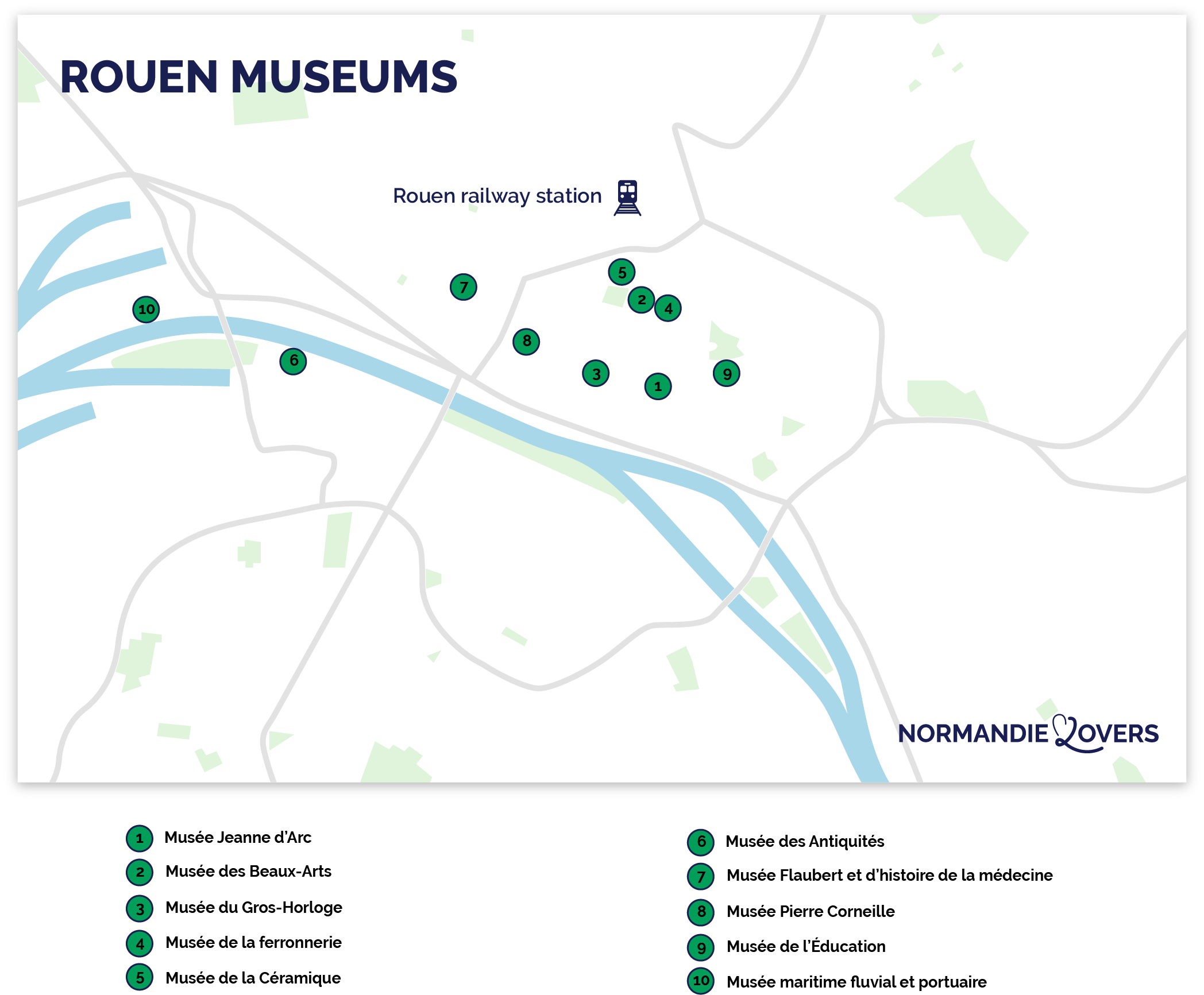
The museum is located at 1 Rue Faucon, Rouen, Normandy, France.
- In the heart of the historic center
- It adjoins the Musée des Beaux-Arts de Rouen.
- 10min walk from Place du Vieux-Marché
- 10-minute walk from Rouen’s Notre-Dame Cathedral
Use our map below to locate the museum in the city:
OUR ADVICE FOR RENTING A CAR IN Normandy
- Compare prices on our preferred platform: DiscoverCars – one of the best rated sites.
- Choose a car that is comfortable enough (distances can be long) but compact (some parking lots and villages are narrow).
- Remember to take outcomprehensive insurance (some roads are winding and narrow).
- There is a lot of demand, book it early.
How to get there?
There are several options for getting to the museum:
- You can walk straight to it from the historic center through Square Charles Verdrel.
- If you prefer public transport, take the bus to the “Square Verdrel” stop, 2 minutes from the museum. Lines 11, 22, F2 and F7 serve this stop. Find out more here.
- You can also get there by car, bearing in mind that traffic in Rouen can be heavy at rush hour.
- The Rouen-Rive-Droite train station is only a 10-minute walk away.
See available timetables and book your train and coach tickets now.

Parking
Parking in Rouen’s historic center can be tricky. If you want to be sure of finding a space quickly, we recommend you visit the Q-Park Palais de Justice Musée des Beaux-Arts parking lot, which is located right next to the museum.
DISCOVER Rouen
- What to do in Rouen: 15 ideas
- Rouen’s tourist calendar: our selection of events
- Where to stay in Rouen: our best hotels
- Where to eat in Rouen: 20 best restaurants
- Rouen’s top 10 museums
- Itineraries in Rouen: 1 day – 2 days
- Rouen Museum of Fine Arts
- Rouen Cathedral
- Rent a car in Rouen

Useful tips: duration, schedules, eating…
Best time to visit
You can enjoy the museum’s collections all year round, as it is not Rouen’s busiest tourist site. However, to avoid the crowds, we advise you to visit outside weekends. You’ll enjoy your discovery of the works even more. You can also visit us at any time of the day during weekday opening hours.

Length of visit and main difficulties
Allow 45min to 1h depending on your interest in the collections.
The museum occupies an old building with many staircases, cobbled floors and wooden floors. We’ve noticed that circulation can be difficult for wheelchair users and people with reduced mobility.
However, the museum does offer guided tours for the visually impaired. You can also take tactile tours or audiodescription tours of the museum’s permanent collection. Guided tours translated into sign language by the Liesse association are also organized. Find out more here.

Advice on how to visit
Before starting your visit, take a quick tour of the garden, from which you can observe the façade of the Hôtel d’Hocqueville. You’ll appreciate the architecture before you enter. Then head into the building and visit the first floor, which showcases early European earthenware and productions from the Rouen workshops of ceramist Masséot Abaquesne. Take time to admire these exceptional pieces before climbing to the first and second floors.
You’ll discover the rooms devoted to the 17th and 18th centuries, housing the heart of the collection, with masterpieces from the history of Rouen earthenware, as well as ensembles from the earthenware centers of the Netherlands, Nevers, Lille and Moustiers. We recommend you finish your tour with a look at the products of the famous Manufacture de Sèvres from the 19th and 20th centuries. The museum also hosts temporary exhibitions. During our visit, the “Fantastic Ceramics” exhibition was underway, revealing some amazing creations!

Visiting with children
The museum has no special facilities for children. It does, however, offer child-friendly tours and workshops. Click here to find out what’s on.

Schedules and rates
The museum is open daily from 2pm to 6pm, except Tuesdays. Closed on January 1, May 1, November 1 and 11 and December 25.
Admission is free.

Guided tours
The museum offers guided tours. Click here for information on times and booking.
Catering
There is no on-site catering option. But you’re right in the heart of Rouen’s historic center. We highly recommend Restaurant Simone for its resolutely creative and daring cuisine, as well as Restaurant Okto, Rouen’s must-try restaurant near the Vieux-Marché. For more choices, check out our article on the city’s best culinary addresses here!

Enter the world of the Musée de la Céramique
Push open the door of a private mansion steeped in history
We invite you to appreciate the architecture of the Hôtel d’Hocqueville from the outside, by taking a stroll in the garden. Built in the mid-17th century and extensively remodeled in the following century, the building still boasts neoclassical interior decorations. Once inside, you’ll discover period furnishings full of character. We particularly liked the rustic cobblestone floors alternating with the elegant Hungarian parquet.

Let yourself be charmed by the elaborate fireplace with its details carved in rock and wood, originating from the Abbey of Saint-Amand, destroyed at the end of the 19th century. Admire the wooden staircases, the late 18th-century oak dresser, the Rouen earthenware dessert table, and the gilded mirror. We were impressed by the quality of conservation of these period features, which create an authentic and refined atmosphere. This historic setting admirably showcases the ceramic collections on display in the various rooms.

Introduction to the art of ceramics
We learned a lot about the art of ceramics during our visit. The term “ceramics” comes from the Greek “keramos” meaning “clay”, so the word designates all products made from fired clay. You’ll discover that there are 4 main families of ceramics, distinguished by the composition of their bodies and their firing methods: pottery (or terracotta), stoneware, earthenware and porcelain. Take time to observe the showcases, which explain all the major stages in the production process, using Rouen ceramics and tools: clay preparation, shaping, molding, firing, glazing and painted decoration. We found this didactic presentation particularly enlightening for understanding the skills of ceramic craftsmen.

We were fascinated to see how the art of ceramics unfolds in different forms: tableware, earthenware sculptures, earthenware paintings, toiletry-themed pieces and many other objects. You’ll also be able to admire a reproduction of an 18th-century toilet, including a pin box, water jug, mirror and scent bottle.

Discover Rouen’s faience masterpieces
Rouen earthenware, exceptional craftsmanship
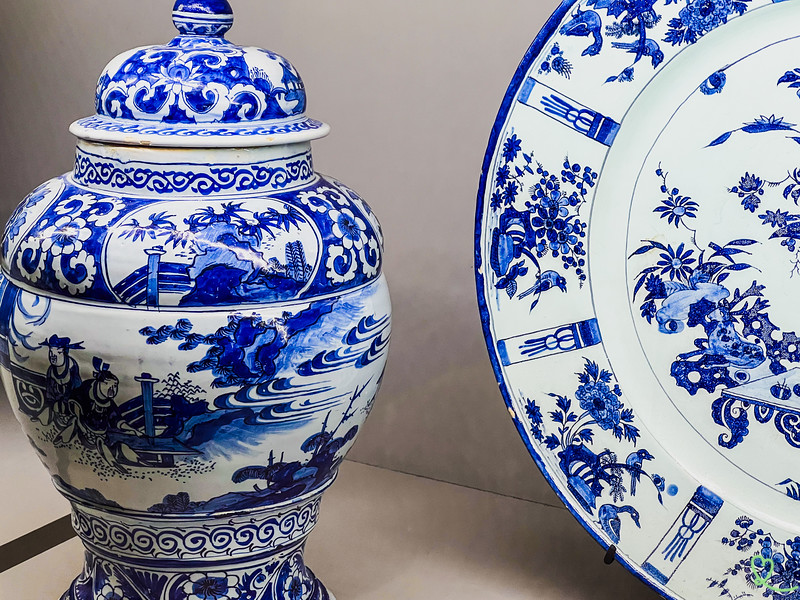
Discover masterpieces from the history of Rouen earthenware, from the 16th to the end of the 18th century. During this period, Rouen was a famous center for the production of high-fired tin-glazed earthenware. Earthenware is said to be “stanniferous” when the ochre paste of the terracotta is covered with a white tin-based glaze improperly called engobe. We learned that high-fired earthenware is decorated before the final firing, directly on the raw glaze, while low-fired earthenware is decorated after firing, on the already-fired glaze, allowing for finer and more varied colors. In this first part of the tour, we were particularly impressed by a terrine lid dating from the late 18th century. Originally from Rouen, this piece features an embossed snake as a hook on a floral background.

Emblematic productions by Masséot Abaquesne
The Rouen workshops of ceramist Masséot Abaquesne include some magnificent floor tiles from the Château d’Écouen. These tiles were used to decorate medieval buildings, both religious and secular. We were particularly impressed by the quality of conservation and the richness of decoration of these exceptional pieces. The intricate patterns and vivid colors testify to the remarkable talent of this 16th-century craftsman. Take time to admire the details of these tiles, which are precious testimonies to the art of the French Renaissance.

Travelling through European ceramics
Ceramics influenced from near and far
You’ll discover collections from the earthenware centers of the Netherlands, Nevers, Lille and Moustiers. We found it particularly interesting to learn about the history of the “blue cameo” phenomenon. Thanks to Portugal, which had been trading with China since the 16th century, blue and white porcelain arrived in Europe and enjoyed great success. Holland was riding the wave, specializing in the production of blue cameos with Chinese decorations. In France, the Nevers workshop spread this fashion to Rouen, creating a veritable European artistic movement.

One piece in blue cameos particularly impressed us during our visit: an earthenware violin made by the Delft workshop (Netherlands) around 1710. This original creation testifies to the technical virtuosity of Dutch craftsmen and their ability to transpose this decorative art into unexpected forms. You’re sure to be fascinated, as we were, by the ingenuity and refinement of these products, which illustrate the cultural and artistic exchanges that took place across Europe.

Exceptional creations from the Manufacture de Sèvres
We continued our discovery with the productions of the famous Manufacture de Sèvres, created in 1740 as a royal porcelain factory. The Musée de la Céramique de Rouen boasts a collection of some one hundred pieces from this prestigious institution. These pieces bear witness to the technical and artistic refinement that has made this manufacture world-renowned. Take time to admire the fine details and bold compositions that characterize these exceptional works.

Here you’ll discover vases, particularly the famous “Les Raisins” vase by Paul-Arthur Massoulle and Julien Alexis Ferry. We were fascinated by this work in which women, surrounded by vines, embrace the large vase. The plant body and nature are part of the decorative vocabulary of ceramics, a characteristic we found in several Sèvres creations.

Frequently asked questions
Does the ceramics museum host temporary exhibitions?
Yes, the museum regularly organizes temporary exhibitions. During our visit, the “Fantastic Ceramics” exhibition was on show. We discovered some very original creations with evocative names: “teapot in the shape of a man riding a bird” or “teapot in the shape of a cane with its sticks”. We were particularly impressed by the works of Valérie Delarue, a contemporary visual artist. His “Vanité aux plantes de pieds” and “Vanité aux corolles” are stunning works featuring human skulls. These daring pieces blend tradition and modernity.

Does the Musée de la Céramique exhibit works by François Pompon?
Yes, you’ll be able to admire a number of works by the famous French sculptor François Pompon, renowned for his animal sculptures. His innovative style is characterized by the simplification of form, creating works of purity and elegance. You’ll see a panther, a bear and a hippopotamus. We appreciated the modernity of these sculptures, which contrast with the museum’s older pieces yet blend harmoniously with them.

PLAN YOUR TRIP TO Normandy
Inspiration destinations
- Deciding where to go in Normandy – the best destinations
- Our weekend ideas: best-of, romantic, unusual, seaside, luxury, family
- 16 seaside hotels in Normandy
- The most beautiful charming hotels in Normandy

Best of

Practice
- Where to stay in Normandy – best places and hotels
- See our tips for renting a car at CDG airport, Orly airport, Beauvais airport, Caen, Rouen, Bayeux…