
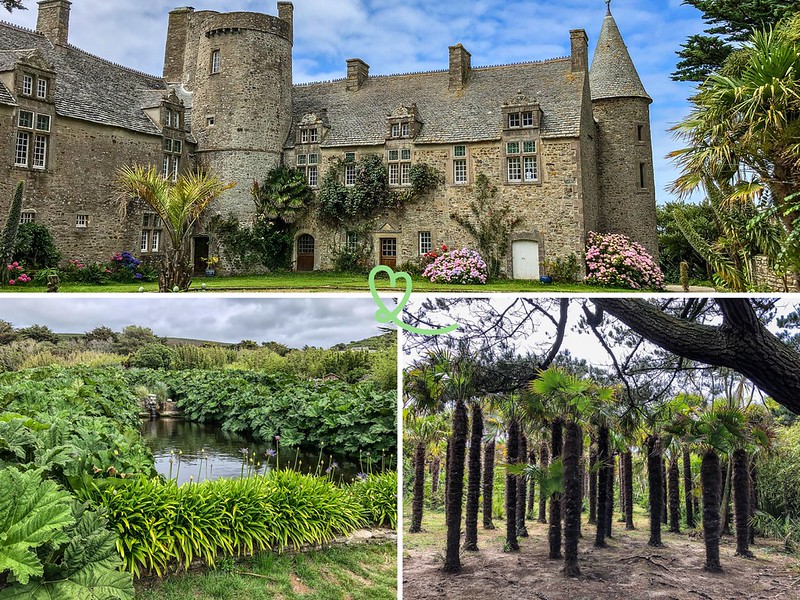
Are you a fan of beautiful gardens? The Vauville Botanical Garden is an oasis located 300 meters from the sea that is home to more than 1,000 species fromthe Southern Hemisphere. Spanning 4.5 hectares, palm trees, giant ferns, and eucalyptus trees surround the Château de Vauville, creating a subtropical atmosphere that is unexpected at these latitudes.
In this article, check out our photos and all our helpful tips for making the most of your visit to the Vauville Botanical Garden!
This guide is completely independent, based on our experiences. We visited the region anonymously, making our own choices and paying our bills in full.
Why visit the Vauville Botanical Garden?
Is the Vauville Botanical Garden worth a visit? Our opinion:
Yes, the Vauville Botanical Garden is definitely worth a visit! We enjoyed moving from one lush room to the next, surrounded by palm groves, ponds, and plants from all over the world. Sheltered from the westerly winds by its hedges, this garden facing the sea remains vibrant throughout the season.
This is one of the most beautiful day trips from Cherbourg! The estate is also included in our selection of the most beautiful castles in Normandy.

Why is the Vauville Botanical Garden famous?
The garden owes its fame to its collection of more than 1,000 species native to the Southern Hemisphere, most of which were grown on site. These plants thrive here thanks to the Gulf Stream, a warm ocean current in the North Atlantic that moderates the climate along the coast.
The site has earned numerous honors: it has been designated a Historic Monument, received the “Remarkable Garden” designation from the Ministry of Culture, and, in 2018, became a member of BGCI (Botanic Gardens Conservation International), a global network of botanical gardens. It is also a “Partner Garden” of the Royal Horticultural Society, the British horticultural society.

Our favorite moments
Here are the three moments that made the biggest impression on us:
- Stroll through the grove of Trachycarpus palms—these palms native to China—and forget for a moment that we’re in Normandy.
- Stop in front of the pond with the gunnera plants, whose giant leaves heighten the sense of being in a different world.
- Catching a glimpse of the castle’s keep and the dovecote between two exotic plantings—a striking contrast.

WHERE TO STAY IN Cherbourg
Option 1: with harbour view
- Mercure Hotel – prices, pictures and availability
- Ambassadeur Hotel – prices, pictures and availability

Option 2: Rest of downtown
- Hotel Le Cercle – prices, pictures and availability
- Hotel Chantereyne – prices, pictures and availability

See our reviews of the best hotels in Cherbourg (coming soon)

Directions and Map: Vauville Botanical Garden, La Hague
Where is the Vauville Botanical Garden located?
- In the village of Vauville, in the municipality of La Hague, at the northwestern tip of the Cotentin Peninsula
- Travel time from Cherbourg (19 km): 25 min
- Travel time from Caen: 2 hours
- Here is a map to help you find your way:

How to get there?
The garden is located in a small coastal village, away from the main roads. Here are your options:
- By car: This is the easiest way to get to Vauville from Cherbourg, which is 19 km to the east.
- By train: The nearest SNCF station is Cherbourg. You’ll then need to arrange for a taxi or a rental car to complete the trip.
- Public transportation: Local service in La Hague is limited

Parking
There is a natural parking area near the entrance.

OUR ADVICE FOR RENTING A CAR IN Normandy
- Compare prices on our preferred platform: DiscoverCars – one of the best rated sites.
- Choose a car that is comfortable enough (distances can be long) but compact (some parking lots and villages are narrow).
- Remember to take outcomprehensive insurance (some roads are winding and narrow).
- There is a lot of demand, book it early.
Useful tips: duration, schedules, eating…
Best time to visit
The garden is open to visitors from late March through October, in the afternoons only (starting at noon on Mondays). Composed largely of evergreen trees and shrubs, the collection remains vibrant throughout the season; we therefore believe that every time of year has its own charms.
Also note that the coast, just 300 meters away, is battered by strong and persistent westerly winds. Be sure to bring a windbreaker: we’ve found that windbreaks protect the paths, but the Cotentin climate can sometimes throw up surprises!

Length of visit and main difficulties
Allow about 1 hour to 1 hour and 30 minutes to explore the garden. However, we recommend that you allow a little extra time if you’d like to take a break at the tea room or stop by the gift shop.
70% of the garden is accessible to people with limited mobility, provided they are accompanied by someone in good physical condition. A map in Braille is also available at the front desk. Good news for pet owners: dogs on a leash are allowed.

Advice on how to visit
A paper map and audio guides are available at the information desk. To make sure you don’t miss a thing, we recommend following the map from one garden to the next—from the palm groves to the ponds—and then finishing with the area around the castle and the dovecote.
Visiting with children
Families will appreciate that admission is free for children under 18, who must be accompanied by an adult. For our part, we find that this botanical journey to the four corners of the globe easily sparks the curiosity of young children.
Schedules and rates
The garden is open during the following hours:
- Late March through September
- Mondays from 12:00 p.m. to 6:30 p.m., Tuesday through Sunday from 2:00 p.m. to 6:30 p.m. (until 7:30 p.m. in July and August)
- Prices: €9.50 per adult, including a map or audio guide. Admission is free for children under 18 accompanied by an adult. You don’t need to make a reservation before you come.
- Individual visitors explore the garden freely, armed with a map
- Latest news on the official website here.

Lodging
Want to extend the experience? The estate offers guest rooms right inside the Château de Vauville: the Painter’s Room, the Traveler’s Room, and the Poet’s Room. Vacation rentals are also available on the estate.
Catering
On site, the Comptoir du Jardinier tea room offers a varied selection of teas and local organic products, as well as savory dishes, rillettes, and terrines in jars. For dessert, treat yourself to some financiers and homemade cookies. We love this kind of tasty treat at the end of a walk!
A Botanical Journey to the Antipodes
Known as the “Traveler’s Garden,” the Vauville Botanical Garden transports its visitors to the other side of the world—right here in Normandy. Follow us as we wander through its paths!
The Green Rooms and the Palm Grove
From the very first steps, we realized that Vauville is unlike any traditional garden. The trail consists of a series of green chambers—spaces enclosed by vegetation that each form their own little worlds. Plants grow freely here, without chemicals, in what appears to be a state of disorder but is in fact the result of careful planning by three generations of enthusiasts.

The grove of Trachycarpus fortunei palms—a species native to China—really made us feel like we were in a different world: it’s hard to believe the English Channel is so close! Take a moment to look up at the towering Lambert cypresses and southern cordyline palms, which give the place its majestic appearance.

Ponds: From Moats to Gunnera Plants
Water plays a central role in the garden. The old stream that once fed the fields now flows from pond to pond, where crinum lilies, royal ferns, and aquatic plants thrive abundantly. In the castle moat, we admired the Tasmanian royal ferns, native to the island of Tasmania, located south of Australia.

Next, stop in front of the impressive pond with its Gunnera manicata: native to Brazil, this plant has giant leaves that enhance the sense of exoticism. Further on, eucalyptus trees stand guard over the Pool of Wisdom. We enjoyed the tranquility of these spaces, which are perfect for a moment of reflection.

A variety of foliage and blooms
Much more than just a flower garden, Vauville features a collection of evergreen trees and shrubs that keep their leaves all year round. We were struck by the variety of shades, ranging from silvery to the deepest green. Bamboos, phormiums, escallonias, and yuccas grow alongside numerous Asian and Mediterranean species.

As you stroll along the paths, you’re sure to notice the amaryllises, Echium pininana, daylilies, callistemon, aloe, and hydrangeas that follow the natural contours of the landscape. The hardiest plants, planted in large numbers, form windbreaks that shelter the more delicate ones. In our opinion, this ingenuity encapsulates the very spirit of the place.

Vauville Castle, the garden’s historic setting
Located in the heart of the village, right next to the church, the Château de Vauville is one of the architectural gems of northern Cotentin. The garden, which faces the sea at a 180-degree angle, now serves as a beautiful setting for it.
The Keep and the Quarters
Two main buildings arranged at right angles frame an inner courtyard. A large tower connects them: this keep, probably dating from the 12th century, is the oldest part of the castle. The circular outer wall and its moat also remain from the original structure. On the stage right side, we spotted the machicolations—those overhanging defensive openings.

On the top floor, a room with a flamboyant Gothic vaulted ceiling is topped by a terrace overlooking the sea and the island of Alderney, one of the Channel Islands. The two dwellings, for their part, date from the 17th-century reconstruction. Take a close look at their mullioned windows, topped by dormer windows adorned with a shell motif: we have learned that this motif can also be found in other manor houses in the Cotentin region, around Bricquebec.

The dovecote
During our walk, we spotted the dovecote, built in 1732 outside the city wall. It has more than a thousand nesting boxes—these niches built into the rock face to shelter the pigeons. Under the Ancien Régime, owning a dovecote was a seigneurial privilege, and its size reflected the importance of the estate.
Don’t miss its silhouette, which is clearly visible from the garden. In fact, its facades and roof have been listed in the Supplementary Inventory of Historic Monuments since 1972, just like those of the castle. We loved this nod to rural life of yesteryear amidst vegetation from Down Under.

One last stop at the store
Before you leave the garden, stop by the gift shop. Garden accessories and tools, seeds, beauty products, candle holders, antiques, or local specialties: you’re sure to find something to take home as a souvenir of your visit. We liked the idea of taking a few seeds home with us, as a way to extend this botanical journey.
History in brief
The garden and the castle share a long history, shaped by several families. Here are the key dates to remember:
- 1163: Richard de Vauville likely began construction of the castle, whose keep probably dates from the 12th century.
- 1520: The castle burned down, as did the town and its market halls.
- 17th century: The two residential wings were rebuilt.
- 1732: Construction of a dovecote with more than a thousand nesting boxes.
- Early 19th century: General Jean-Léonor Le Marois, aide-de-camp to Napoleon Bonaparte, purchased the castle.
- 1948: Eric Pellerin, a perfumer and traveler, and his wife Nicole planted the garden on what had once been a pasture.
- 1972: The facades and roofs of the castle and the dovecote were listed in the Supplementary Inventory of Historic Monuments.
- 1980s: Landscape architect Guillaume Pellerin and his wife, Cléophée de Turckheim, expanded the garden and gave it its current appearance.
- 1992 and 2004: The garden was designated a Historic Monument and later awarded the “Remarkable Garden” designation.


Frequently asked questions
Can we tour the interior of the Château de Vauville?
No, it’s also possible to stay there in a bed-and-breakfast or enjoy a group meal there, by reservation.
Is the garden open year-round?
No, the garden is open from late March through October. Groups can contact the garden to schedule a visit by appointment.
What is there to see near the Vauville Botanical Garden?
The garden invites you to continue your exploration toward the Mare de Vauville Nature Reserve and the wild heathlands that overlook the site. We also recommend combining your visit with a trip to the Nez de Jobourg, another must-see attraction in La Hague. For more ideas, check out our article “Things to Do in Cherbourg“!
PLAN YOUR TRIP TO Normandy
Inspiration destinations
- Deciding where to go in Normandy – the best destinations
- Our weekend ideas: best-of, romantic, unusual, seaside, luxury, family
- 16 seaside hotels in Normandy
- The most beautiful charming hotels in Normandy

Best of

Practice
- Where to stay in Normandy – best places and hotels
- See our tips for renting a car at CDG airport, Orly airport, Beauvais airport, Caen, Rouen, Bayeux…