
Passing through Normandy and passionate about the history of World War 2? Then the Musée du Débarquement d’Arromanches is a must on your list! Did you know that this is the 1st museum dedicated to the D-Day Landings, built in 1953 at Gold Beach? We walked in the footsteps of the history of the artificial port of Arromanches and the D-Day landings of June 6, 1944. We appreciated its recent restoration, which makes it a modern, immersive place of remembrance overlooking the sea and the remains of the port.
In this article you’ll find some useful tips to help you prepare for your visit!
This guide is completely independent, based on our experiences. We visited the region anonymously, making our own choices and paying our bills in full.
Why visit the Arromanches D-day Museum?
Is the museum worth it? Our opinion:
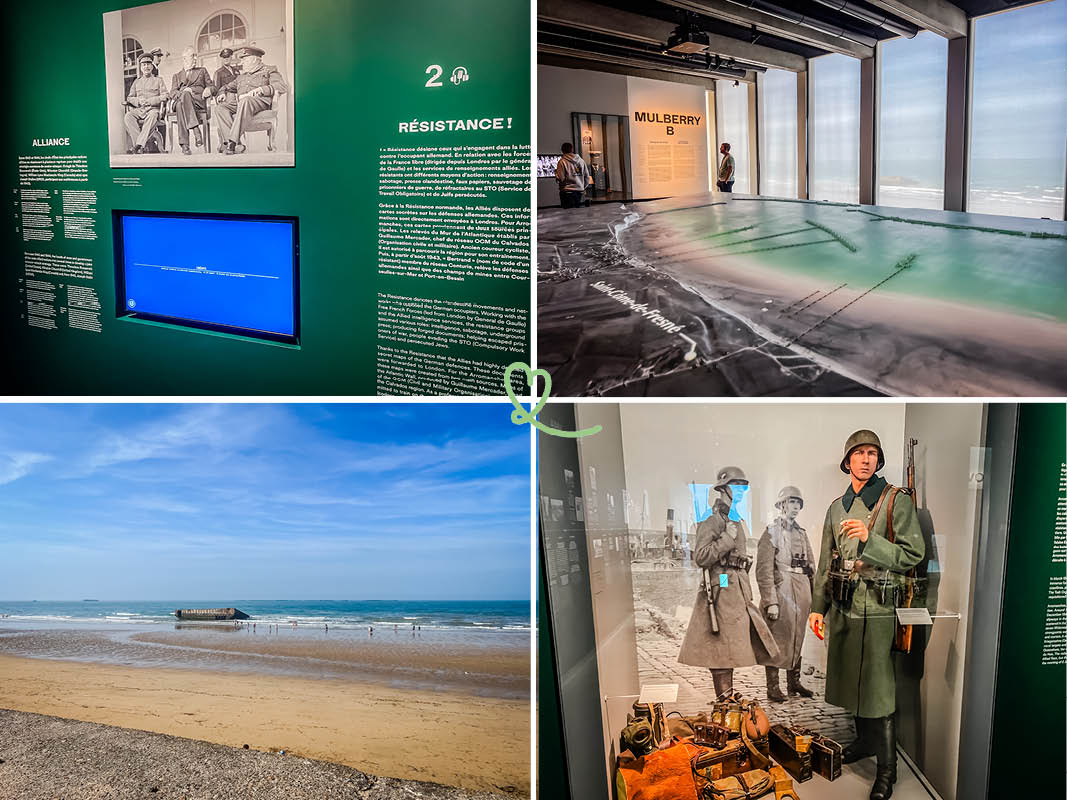
Yes, the museum is well worth a visit. Completely restored between 2022 and 2023 near the beach Gold Beach, its new modern and immersive museography seduced us. Here, we discovered the technological challenge of prefabricated harbors through dynamic exhibits on 1200m2 and an impressive video mapping on a 28m2 model of Mulberry’s artificial harbor. Our tour ended with this immersive moment that plunged us into the heart of history, with the real Plage d’Arromanches in the background behind the picture windows. The icing on the cake is a visit to the top floor, where the roof terrace offers a panoramic view of the surrounding area!
This tour is one of the best things to do at Gold Beach.

Why is the museum famous?
The Musée du Débarquement d’Arromanches is famous for being the 1st museum dedicated to the D-Day landings. Inaugurated in 1954 by French President René Coty, it presents the history of the Mulberry artificial harbor. Find out more about this technical feat, essential to the success of the Allied offensive known as Operation Overlord. We appreciated its strategic position, directly opposite the remains of the artificial harbour still visible in the bay at low tide.

Our favorite moments
You can read more about our visit in this article, but we’re sharing our favorite moments with you right now:
- Once inside, take note of the large 16-metre longitudinal rift that elegantly structures the interior spaces. Once inside, take note of the large 16-metre longitudinal rift that elegantly structures the interior spaces. The introductory film shown in the cinema on the first floor perfectly contextualizes the visit.
- Display cases containing period objects that belonged to the soldiers
- The large animated model of Port Mulberry, a true masterpiece of precision

History in brief
Here are the key dates in the museum’s history:
- 1953: Museum opens to the public
- 1954: Official inauguration by President René Coty
- 2022-2023: Extensive restoration of the museum and change of building
- April 1, 2023: Inauguration of the restored museum by President Emmanuel Macron

How to get there: Musée du Débarquement d’Arromanches-les-Bains, Normandy
Where is the museum?
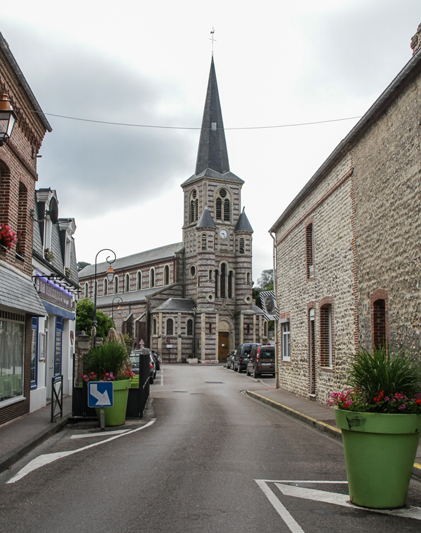
The museum is located in Arromanches-les-Bains town center, Place du 6 Juin (15min drive from Bayeux). Located close to the Plage de Gold Beach, it offers a breathtaking view of the remains of the artificial harbour.

OUR ADVICE FOR RENTING A CAR IN Normandy
- Compare prices on our preferred platform: DiscoverCars – one of the best rated sites.
- Choose a car that is comfortable enough (distances can be long) but compact (some parking lots and villages are narrow).
- Remember to take outcomprehensive insurance (some roads are winding and narrow).
- There is a lot of demand, book it early.

How to get there?
There are several options for accessing the museum:
- by public transport, take the train to Bayeux (less than 3h from Paris, about 15min from Caen) then a cab or rental car (15 to 20min drive)
- by Vélomaritime to Port-en-Bessin (see here)
- by bus (line 121) from Ver-sur-Mer to Bayeux (stop Arromanches-les-Bains)
- by car – see our tips for renting a car in Bayeux

Parking
There are 2 pay parking lots nearby:
- Rue du Petit-Fontaine less than 5 minutes’ walk from the museum
- Boulevard Gilbert Longuet less than 10 minutes’ walk from the museum
See all parking options in Arromanches-les-Bains here.
MORE ABOUT THE D-Day sites
- The best landing sites to visit
- Visit the 5 D-Day landing beaches
- Where to stay – best hotels near the beach
- The best D-Day museums in Normandy
- German batteries to visit
- Car rental tips: Caen – Roissy-CDG – Orly – Beauvais
- Visit Omaha Beach
- Visit Utah Beach
- Visit Gold Beach
- Visit Sword Beach
- Visit Juno Beach (coming soon)
Useful tips: duration, schedules, eating…
Best time to visit
The best time to visit is from May to September, but be prepared for a busy summer in July and August. We advise you to avoid these months if you want a more leisurely visit. You can also visit in autumn, winter and spring, when it’s less crowded and Normandy is just as pleasant with a few drops of rain. Please note that the museum closes on December 24, 25, 31 and January 1, and from January 6 to 31, 2025.

Length of visit and main difficulties
Allow around 1h30 to take full advantage of the fun and educational exhibits. The museum, which will be completely renovated between 2022 and 2023, covers 1,000m² indoors, with smooth floors and a modern, well-maintained building. The new layout makes it easier for visitors to get around, which we really appreciated when we were there! Lockers are available on the first floor near the changing rooms and stroller area for your convenience.

Advice on how to visit
There is no imposed direction of visit. We recommend that you follow the sequences from the first floor upwards. When you arrive, you can start at the memorial esplanade facing the sea before entering. Can you see the remains of the artificial harbour at low tide?
Inside the building, let yourself be guided by the introductory film that contextualizes the visit. Continue with the animated model and diorama exhibition upstairs, where you can learn more about the construction and operation of the port. The rooms dedicated to the various nations then await you, with their artefacts, uniforms and period photographs. Finish your tour with the impressive video mapping on the 28m² model, before enjoying the view from the roof terrace. Enjoy your visit!

Visiting with children
Out and about with your kids? The museum offers an interesting experience for younger visitors. From the introductory film shown in a dedicated cinema at the start of the tour, to the projected archive images, fascinating models and reconstructions, this historic site is sure to please young and old alike! The bright building on the seafront also offers a pleasant setting, not forgetting the pine garden where your little ones can relax between 2 discoveries.
A children’s trail for ages 6 to 10 was designed during the restoration of the site. A little boy named Pierre recounts in the words of a child what life was like in Arromanches during the Occupation until the Liberation, and how the port was built. Ask for more information at reception when you arrive!

Schedules and rates
The museum is open at the following times:
- February: 10am-5pm
- March to October: 9:30-17:30
- May to August: 9am-7pm
- April to September: 9am-6pm
Prices are as follows:
- Adult: €12.90
- Children/students: €8.30
- Family (2 adults + 2 children): €37
- Group rate: €9.20
Find out more on the official website here.
Guided tours or audioguide
Audio guides are available in 10 languages (French, English, Italian, German, Dutch, Spanish, Czech, Chinese, Hebrew, Polish) and are included in the ticket price. We found the 1.5-hour audio tour very well designed, allowing you to discover the history of the site at your own pace. Groups can also choose a specific 45-minute audioguide option.

Catering
The museum has no catering facilities. For a gourmet break, stop off at the Compagnie des Glaces opposite the museum. We advise you to head to Bayeux for lunch, where you’ll find several excellent restaurants in our suggestions here. If you’d like to eat in Arromanches-les-Bains, there are several dining options available in this tourist area of the D-Day landing beaches, but we haven’t tested them.

An emblematic and pioneering museum in Gold Beach
A unique panorama of the remains of the artificial harbour
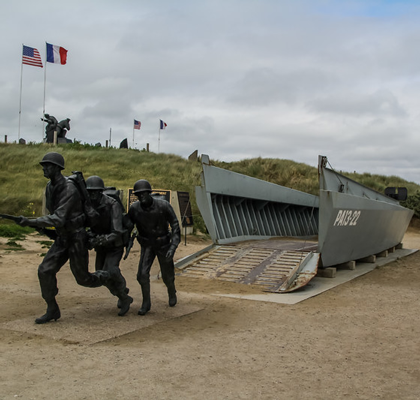
From the museum’s memorial esplanade, we enjoyed admiring the view over the whole bay of Arromanches. The remains of the artificial harbour that emerge at low tide alone tell the story of the scale of the D-Day operation. You can observe these witnesses to history from different vantage points throughout your visit. This proximity to the remains lends a moving dimension to the visit and creates a direct link between the museum’s explanations and these impressive structures that have survived the decades. We felt like we could touch history with our fingertips!

The modern architecture of the building overlooking the beach
The museum building is distinguished by its contemporary architecture, harmoniously integrated into the historic site. We were impressed by this large, elevated building, with its spectacular views over the beach and the remains of the artificial harbour. Inside the museum, you’ll notice that the building is bathed in natural light thanks to the large bay windows that punctuate the façade. The prefabricated posts in Claire concrete around the perimeter of the building follow differentiated grids. Raise your head as you arrive: an imposing canopy 4m deep and 8m high marks the entrance from the Place du 6 juin 1944.

Once inside, you’ll notice the large, 16-metre-long longitudinal rift that elegantly structures the interior spaces. It provides a space for projecting archive images of the events of the night of June 5-6, 1944.

A captivating and immersive museum tour
History through images
Your journey will begin with an introductory film of around 8 minutes that has made a lasting impression on us. This projection traces the history from the Treaty of Versailles to the construction of the artificial harbor at Arromanches, providing essential background for the rest of the visit.

As mentioned in the previous section, the central fault is also a place where beautiful archive images are projected.
For us, however, the highlight of the exhibition is the space devoted to the working port. We were fascinated by the gigantic 25m2 model. On this surface, you’ll discover an innovative video mapping that uses light to illustrate the daily construction of the port. A new approach that brings history to life and makes for an immersive experience!
Exceptional collections of reconstructions and period objects
The collections are organized around 7 thematic sequences. We were particularly impressed by the room dedicated to Europe under German occupation, which showcases acts of French resistance and the work of British spies. Below, we’ve captured a beautiful image of a staff stamp. It was used to stamp letters and documents relating to the 716th German Infantry Division, found in 1944. Fascinating, isn’t it?

The section devoted to the assault features a striking 7-minute archive film on Operation Neptune, accompanied by showcases displaying authentic objects. You will also be able to discover a remarkable collection including Commandant Philippe Kieffer’s jacket, an Enfield No.2 revolver. MK 1, and a number of soldiers’ personal items, such as this notebook with several English words translated into French. These period objects brought us a little closer to their daily lives!

Between models and archives, the must-sees of our visit
The model of the Longues-sur-Mer Battery
Young and old alike are sure to love this part of the course! Zoom in on the model of the Longues-sur-Mer Battery, which impressed us with its size and precision. This meticulous reconstruction represents this emblematic site nestled on the cliffs of the Normandy coast. By observing it, we were able to understand the strategic importance of this fortress, which was part of the German defensive system of the Atlantic Wall. The carefully reproduced details will give you an idea of the scale of the facilities that played a crucial role in the D-Day landings on June 6, 1944. It was all the more interesting and intriguing to see this model, as we had already visited this iconic site before!

The large animated model of Port Mulberry
Drum roll! Also upstairs, you’ll find that the animated model of Port Mulberry is undoubtedly one of the museum’s highlights. What really caught our attention was its true orientation towards the sea. You’ll be able to make a direct link between the remains visible through the museum’s large windows and the elements represented on the giant model.

This ingenious staging will give you an in-depth understanding of how the artificial harbor works. What’s most impressive, in our opinion, is the meticulous work of the model-makers, who were able to reproduce every detail of this colossal infrastructure. A clear view of this historic feat of engineering, in miniature! And if you look through the picture windows, you’ll see the real beach and its remains.

Viewpoints to understand the scale of D-Day
Throughout the visit, both inside and outside the museum, we enjoyed the views of Arromanches Bay, the surrounding area and the remains of the artificial harbor from the windows and the various models. On the giant model of the Mulberry B port, these varied perspectives let you grasp the immensity of the D-Day operation.

The museum’s terrace, which has been open to the public since 2024, also offers a breathtaking panoramic view of the entire historic site. From these vantage points, you can contemplate the still visible traces of this monumental infrastructure, which played a decisive role in the success of the D-Day landings.

Finally, at the end of the visit, we enjoyed the museum’s 7th and last sequence, which bridges the gap between the events of D-Day and the Battle of Normandy through films and archive images. You’ll even see underwater relics, like the fighter-bomber engine in the image above, found 5m below the surface in Normandy.
In fact, we were lucky enough to visit the museum dedicated to this other significant episode in history in Bayeux (15min drive from Arromanches), a place well worth a visit.
Frequently asked questions
Can the remains of the artificial harbour be seen all year round?
Yes, the remains of the artificial harbour are visible all year round, especially at low tide. We recommend starting your visit at the memorial esplanade in front of the museum, for a panoramic view of the bay. You can also see them from the Place du 6 juin 1944 and the coastal promenade on Plage d’Arromanches (Gold Beach). The renovation of the museum between 2022 and 2023 has highlighted these beautiful vistas with large bay windows.

Which museum to visit on the D-Day landing beaches?
The Arromanches D-day Museum is one of the must-see sites on the D-Day landing beaches. Its new immersive museography and unique location make it an essential milestone. However, there are many historical sites that tell the story of this pivotal moment in history. We’ve compiled a list of the best D-Day museums here to help you choose.

Take note of a few additional suggestions if you wish to combine the Arromanches Landing Museum with other historic sites:
- From Paris, 1-day combined tour with Pointe du Hoc and Gold Beach – see details here
- From Caen, tour of the British D-Day area – see details here
- Discover the region by bike with a tour fromOmaha Beach to Gold Beach – see details here
PLAN YOUR TRIP TO Normandy
Inspiration destinations
- Deciding where to go in Normandy – the best destinations
- Our weekend ideas: best-of, romantic, unusual, seaside, luxury, family
- 16 seaside hotels in Normandy
- The most beautiful charming hotels in Normandy

Best of

Practice
- Where to stay in Normandy – best places and hotels
- See our tips for renting a car at CDG airport, Orly airport, Beauvais airport, Caen, Rouen, Bayeux…


HE MADE THE TRIP Manu