
Are you planning to visit the Musée des Beaux-Arts de Caen? It’s a must-see! Located inside the castle ramparts, this is one of France’s most important museums for 16th and 17th century European painting (France, Italy, Flanders, Holland). His collection of prints is also well known.
If you’re a fan of contemporary art, you’ll also be delighted by the rooms devoted to the avant-gardes of the 19th and 20th centuries. With its rich program, restaurant and freely accessible contemporary sculpture park, the museum brings culture to life in Caen!
In this article, we give you all our advice in pictures to make the most of your visit!
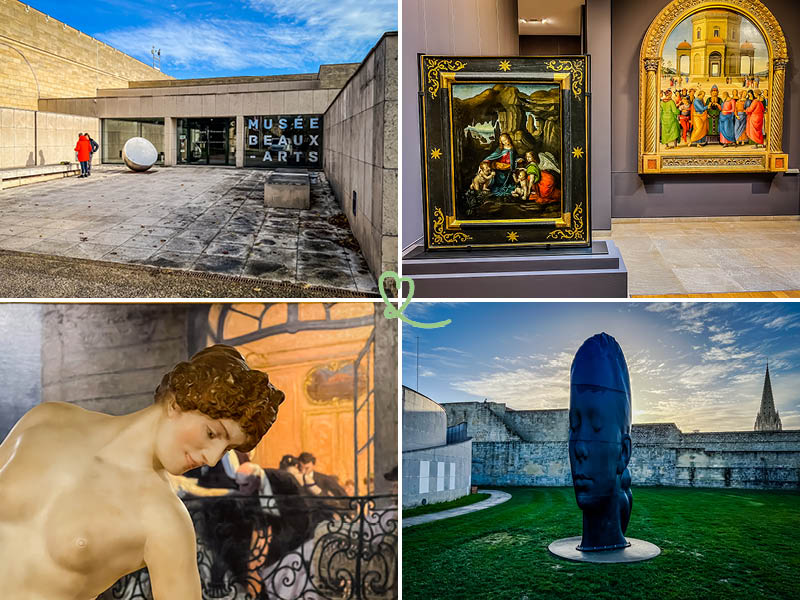
This review is completely independent, we visited anonymously and paid our admission in full.
Why visit the Musée des Beaux-Arts de Caen?
Is Caen’s Musée des Beaux-Arts worth a visit?
Absolutely! In fact, we listed it in our article on the best things to do in Caen. This is a very comprehensive museum, offering a vast panorama of the fine arts, in France and Europe, from the 15th to the 21st century. You’ll see works by the great masters (Brueghel, Perugino, Tintoretto, Veronese, Rubens, Tiepolo, Poussin, Boucher, Monet, Courbet, Soulages…). You’re sure to enjoy a quality temporary exhibition during your visit, and discover new contemporary artists.

Why is Caen’s Musée des Beaux-Arts famous?
The museum is first and foremost famous for its unique collections. It is a benchmark institution in France for paintings from the Northern, Italian and French schools, covering the 16th and 17th centuries. What’s more, its print cabinet contains over 50,000 works by great names (Rembrandt, Dürer) from the Fonds Mancel collection, bequeathed to the museum in 1872.
Last but not least, the freely accessible sculpture park brings the château to life with exceptional contemporary works, such as Huang Yong Ping’s One man, nine animals, created in 1999 for the French pavilion at the 48th Venice Biennale.

What we liked best
Although this selection is obviously influenced by our artistic tastes, we’d like to share with you our favorites from the visit:
- The Lou sculpture (2015) by Jaume Plensa: we found this face, in the sculpture park, quite simply impressive!
- The Italian Renaissance section (first floor): we thoroughly enjoyed this part of the visit, punctuated by the splendid triptych of The Virgin and Child between St. George and St. James, by Cima da Conegliano.
- Normandy painted by the avant-garde, for example with the work Retreat. La Manneporte, reflections on the waterby Claude Monet.

Subscribe to our Newsletter
- Get away from it all with Region Lovers’ beautiful destinations!
- Once a month
- Advertising-free
Practical tips and map: Musée des Beaux-Arts, Caen, France
Where is the museum?
The Musée des Beaux-Arts is located in the grounds of the Château de Caen (14000), in the Calvados département of Lower Normandy.
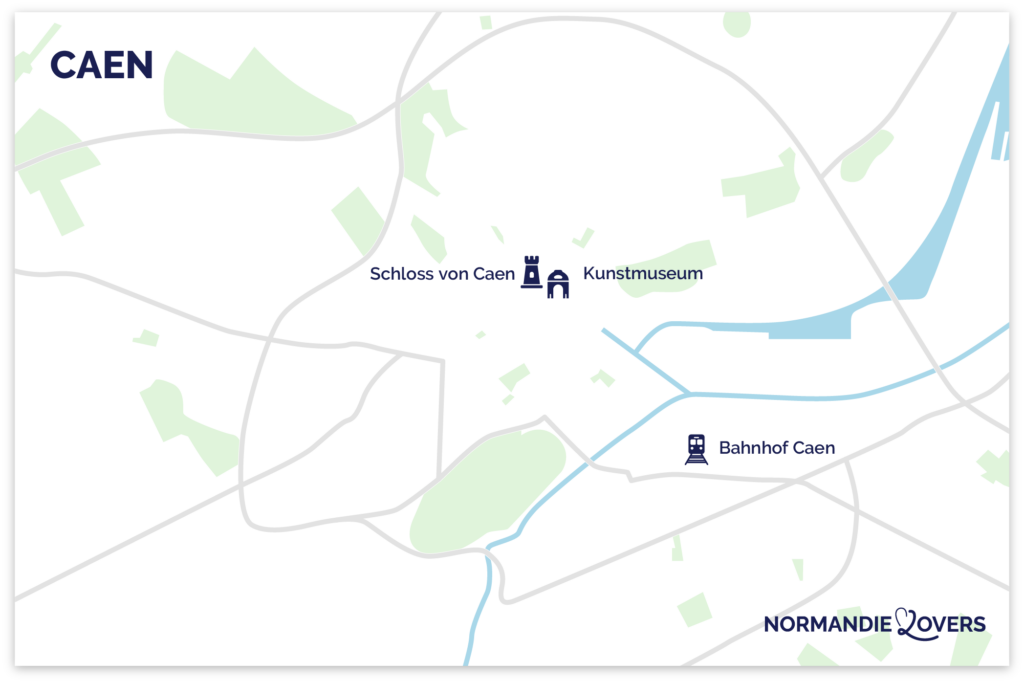
- Driving time from Rouen: 01h30min.
- Driving time from Evreux: 01h45min.
- Driving time from Alençon: 01h25min.
- Driving time from Cherbourg: 01h30min.
- Driving time from Mont-Saint-Michel: 1h30min.
How to get there
We recommend driving to Caen if you also want to visit the rest of Normandy without time constraints. Otherwise, it’s best to go by train. Caen’s ring roads are particularly congested at peak times, as is the historic center, which can be difficult to navigate.
Regular TER lines serve Caen from Paris Saint-Lazare, as well as from Le Mans and Rennes.
See available timetables and book your train and coach tickets now.
From there, it’s a 15-minute ride on public transport or a 30-minute walk to the museum.

You’ll be spoilt for choice when it comes to getting there by bus, with these stops located around a 10-minute walk from the museum:
- University/Quatrans/Bellivet stops: lines A, B, 10, 14, 18, 19, liane 4.
- Tour Leroy stop: line A express, liane 2, line 5.
- Place Courtonne stop: line 8.
- Port de Plaisance stop: line 20.
You can also opt for the tramway:
- T1: Château-Quatrans or Saint-Pierre or Université stops.
- T2: Château-Quatrans or Saint-Pierre or Université stops.
- T3: Saint-Pierre or Château-Quatrans (Terminus) stops.
You’ll also find 3 self-service Vélolib stations close to the museum, available 24 hours a day:
- Campus 1 (2, Rue des Terrasses).
- Place Bouchard (3, Place Pierre Bouchard).
- Port – Place Courtonne (Quai Vendeuvre).
To plan your route, visit the official Caen transport network website.

Parking
The museum has no dedicated parking lot, and it is not possible to drive into the château. However, there are a number of nearby parking lots:
- Château underground parking lot (Parking Indigo – Access via rue du Vaugeux then Avenue de la Libération).
- Courtonne outdoor parking lot (access via Quai Vendeuvre).
OUR ADVICE FOR RENTING A CAR IN Normandy
- Compare prices on our preferred platform: DiscoverCars – one of the best rated sites.
- Choose a car that is comfortable enough (distances can be long) but compact (some parking lots and villages are narrow).
- Think of thecomplete insurance (some roads are tortuous and narrow).
- There is a lot of demand, book it early.

Schedules and rates
The museum is open:
- September to June: Tuesday to Thursday, 9.30am to 12.30pm and 1.30pm to 6pm, Saturday and Sunday, 11am to 6pm.
- July to August: regular opening hours, with additional opening on Mondays from 9:30am to 12:30pm and from 1:30pm to 6pm.
- Closed: January 1, Easter Sunday, May 1, Ascension Day, November 1, December 25. The museum closes at 4pm on December 24 and 31.
Last ticket sales at St. George’s Church are at 5.15pm, and last admission to the museum is at 5.30pm.
The store is open under the same conditions as the museum, except from Tuesday to Friday, when it only opens at 10am.

Prices for visiting the museum are as follows:
- Full adult rate (access to permanent collections): €3.50
- Full adult price (access to permanent collections + temporary exhibitions): €5.50
- Reduced rate (access to permanent collections): €2.50
- Reduced rate (access to permanent collections + temporary exhibitions): €3.50
- Free admission: for under-26s, for all on the first weekend of the month.
To consult the latest rates and the complete list of free and reduced rate beneficiaries, visit the official website.
Last but not least, there are some great money-saving passes:

How long to visit the museum and main difficulties
You’ll need about 1 hour to visit the museum, and up to 2 hours if you’re an art history buff. The route is not particularly difficult.
Elevators and toilets are reserved for people with motor disabilities, as is a parking space on the château grounds. Wheelchairs and cane seats are available on loan from the museum reception desk.
The museum is also dog-friendly. Tailor-made tours and workshops are available to suit all types of disability.

Best time to visit the museum
The Musée des Beaux-Arts is a must-see in Caen. Its privileged location within the castle makes it a popular site, especially at weekends between 3pm and 5pm. If you can, we advise you to go during the week, preferably outside the school year. If you’re an early riser, we recommend you get there as soon as it opens!

Advice on how to visit
We advise you to follow the direction indicated. The tour begins on the first floor, where you’ll also find the store, toilets, an elevator, access to the auditorium and Le Mancel restaurant, and the temporary exhibition room. You’ll discover works from the 14th to 17th centuries, from the French, Italian and Northern schools.
The tour continues on the garden level (-1), where you’ll find toilets, the graphic arts room, library and art studio. This floor is devoted to fine art from the 18th to the 21st century. Now all you have to do is get out and enjoy the sculpture park!

Caen Museum of Fine Arts with children
The museum offers fun activities for children aged 3 to 12: storytelling tours, games, musical siestas, drawing workshops… During the school vacations, courses are offered, particularly for teenagers (paintings…).
For more information, see the program on the official website.
Finally, a games area is available on the museum’s website, where you can play with art history (Timeline, puzzle…).

Guided tours
The museum offers all kinds of tours (descriptive, guided, sketch tours…) for between €4 and €6. To find out more, visit the official website.
Audioguides are available for €4 in addition to your museum admission.
If you want Caen to have no more secrets for you, opt for a city tour with a local guide!

DISCOVER Caen
- What to do in Caen
- Where to stay in Caen: our best hotels
- Where to eat in Caen: our best restaurants
- Caen’s best museums
- Itineraries: 1 day – 2 days
- Caen Castle
- Caen Memorial Museum
- Rent a car in Caen: our tips

Museum restaurant: Le Mancel
The château’s restaurant, Le Mancel, is now open:
- Wednesday to Saturday, 9am to 2pm and 7pm to 10pm. A tea room is available from 2pm to 7pm.
- Sundays from 9am to 2pm and as a tearoom from 2pm to 7pm.
- Closed Mondays and Tuesdays all day, Sunday evenings and December 24 and 25.
You can enjoy a starter/main course/dessert menu for around 30 euros.

Nearby restaurants
If you’d rather eat outside the castle grounds, here are our recommendations, which you can find in our article on the best restaurants in Caen.
- Restaurant l’Aromate: refined, affordable cuisine with local flavors.
- L’Okara vegan canteen: a convivial place to enjoy organic, ethical and affordable products.
- Bar Moon & Sons: this subdued pub inspired by the world of Harry Potter offers a 100% plant-based menu (dishes, pastries and snacks).
WHERE TO STAY IN Caen
Option 1: in the old town center
We recommend..:
- Hotel Best Western Plus Le moderne not far from the castle – see prices, photos and availability
- Hotel La Fontaine also near the castle – see prices, photos and availability
- B&B Les Chambres de L’Abbaye, near Abbaye-aux-Hommes – see prices, photos and availability

Option 2: to Ouistreham
To sleep more in the countryside or near the beach (15 to 20min from Rouen). We recommend..:
- Hotel Manoir Hastings and its stone houses – see prices, photos and availability.
- Hotel La Mare Ô Poissons and its swimming pool – see prices, photos and availability

Option 3: near the port or station
We recommend..:
- Campanile hotel next to the station – see prices, photos and availability.

Fine arts from the 14th to the 17th centuries
The Italian School
The museum tour begins on the first floor, with an initial immersion in Italy. The first, rather small, room features works from the 14th to 16th centuries. 2 works in particular caught our attention. Firstly, the triptych of the Madonna and Child we have already mentioned, and a representation of St. James by the Ferrara painter Cosmé Tura. This oil-on-canvas shows Renaissance features such as perspective, and late Gothic features such as the griffins on the throne.

Then turn left to enter the next room, dedicated to the Vénise painters. Don’t miss Veronese’s first masterpiece, The Temptation of Saint Anthony (1552), which was to decorate Mantua Cathedral.

Continue on to the adjoining room, dedicated to the 17th century. Here you’ll find numerous representations of mythological scenes from Ovid’s “Metamorphoses”. This is not the case for our favorite work at the far end of the room. Coriolan supplié par sa mère (1640) by Le Guerchin, a famous pupil of the Carracci family, was destined to adorn the Italian gallery of the Hôtel de La Vrillière or Hôtel de Toulouse, in Paris.

The French School
After Italy, this time we’re immersed in the history of our own country. The great painters of the 17th century are exhibited here, including the great rivals of Louis XIV’s court: Philippe de Champaigne, Charles le Brun and Pierre Mignard. We immediately noticed Le vœu de Louis XIII at the back of the room. It was commissioned by Louis XIII from Philippe de Champaigne to adorn the high altar of Notre-Dame Cathedral in Paris.

To admire other 17th-century French paintings, head for the corridor around the atrium. You’ll see a majority of portraits.

L’École du Nord
The museum has a rich collection of Ecole du Nord paintings. We were delighted to discover it as soon as we entered the room next to the one devoted to 17th-century French painting. We took a long look at a masterpiece: The Tithe Payment or Bethlehem Enumeration by Pieter Brueghel the Younger.

Other great names from this school can be seen in the room dedicated to Flanders, where we were able to see a painting by Rubens. But it was the expression of an old man that struck us the most. We came across an oil on wood entitled Figure of an Apostle at Prayer, painted by Flemish artist Jacob Jordaens, a contemporary of Van Dyck. We’ll long remember that face, scarred and imploring!

USE OUR GUIDE TO PLAN A
DREAM TRIP TO Normandy
All the information you need for your trip:
- 8 maps that make planning easier
- 160+ pre-selected locations
- Practical advice
- 300+ photos to help you choose
From the Cabinet des estampes to portraits and landscapes (18th-19th centuries)
The Cabinet des Estampes
The tour continues down to level -1. You’ll then come across the graphic arts cabinet. The 50,000 prints kept by the museum are in reserve most of the time. Graphic works are very fragile and can only be exhibited for a short time. As a result, the cabinet is used for temporary exhibitions. At the time of our visit, only works by a self-taught contemporary artist, Pascal Casson, were on display. We were a little disappointed. Be sure to check out the exhibits on display in the office before your visit!

Pass the art studio and library to access the permanent collections on this level.

Portraits and landscapes in the 18th century
The first room is devoted to art in 18th-century Europe. You’ll see mostly paintings, but also some sculptures and decorative art (chest of drawers, plates from the Manufacture de Caen…). We liked the fact that it was more diverse than the upper floor.

We also enjoyed seeing other countries represented. For example, a landscape by Luis Paret y Alcazar, a contemporary of Goya, caught our eye. You can see the beach at Fontarabie, at the foot of the ruins of Charles V’s castle on the left.

The next room exhibits exclusively French painters. Although the 18th century is indicated for this room on the tour map, there are also paintings from the 19th century. Some of them are landscapes, like this series by Jean Pillement (1728-1808).

Numerous portraits are also on display, including allegorical ones. We spotted an oil on canvas depicting three children personifying love, innocence and discretion.

The great names of the 19th century
Although the museum’s collection is limited to the 19th, 20th and 21st centuries, it includes works by major painters such as Courbet, Thomas Couture, Théodore Géricault and Gustave Doré. Once again, there are many landscapes, notably by painters from the Barbizon school. Below you can see the banks of the river Oise, painted by Charles-François Daubigny.

Some genre scenes are part of the collection, notably this painting by Octave Tassaert, entitled La Ramasseuse de fagots, which really struck us. We were moved by the expression of this little girl in the middle of winter, in a painting that could fall into misery, but avoids it.

Subscribe to our Newsletter
- Get away from it all with Region Lovers’ beautiful destinations!
- Once a month
- Advertising-free
Contemporary art at the Musée des Beaux-Arts
The avant-garde and Normandy
This part of the tour is one of our favorites. In fact, it focuses on works whose main theme is Normandy, painted by avant-gardists. These are the beaches most popular with painters such as Paul Huet and Eugène Boudin. Étretat, Trouville and Le Havre are well represented.

With our strong link to Le Havre, we couldn’t resist sharing this work by Albert Marquet with you. The King’s Basin takes on a whole new aspect with the painter’s fauve touch!

Finally, don’t miss the highlight of the visit, this view of the cliffs of Étretat by Claude Monet.

Cubists and other twentieth-century artists
Other major 20th-century artists have their place in the museum’s collection. You’ll come across works by Pierre Bonnard and Henri Lebasque. Raoul Dufy, a native of Le Havre, has an important place in this institution. We were interested to discover that he had worked on fabric patterns for tapestries (below).

You’ll also be able to see a splendid canvas by a leading figure of Cubism, André Lhote. He revisits Cézanne’s painting with his own version of the bathers theme.

If you’re not a fan of cubism, you won’t be disappointed. We were surprised to see works from other artistic movements, such as Surrealism, in the Cubist room. Artists such as Félix Labisse and Léopold Survage were exhibited.

Thanks to a proactive acquisition policy since the 1970s, the museum has acquired many contemporary works, which are now displayed in the atrium. French and international artists alike are showcased in a streamlined scenography.

The sculpture park
Your visit will undoubtedly conclude with a visit to the sculpture park. Since 2007, a series of modern and contemporary sculptures have been installed in the château’s grounds. The most famous is undoubtedly the face of a little girl called Lou, by artist Jaume Plensa. Right at the entrance to the museum, you can’t miss this sculpture, which we loved and which has become emblematic of Caen!

Other 21st-century works also adorn the park. Huang Yong Ping’s monumental ensemble, One man, nine animals, created in 1999 for the French pavilion at the 48th Venice Biennale, is impressive! More famous artists, this time from the 20th century, make their mark in the garden. In addition to Rodin’s La Grande Ombre, we were able to admire Le Grand Guerrier, created by Antoine Bourdelle between 1894 and 1900.

After your visit, we recommend a well-deserved coffee break in the château’s tearoom!
Please note that the château is being renovated between 2023 and 2025, the sculptures are no longer visible in the Park. The “Lou” and “Grand Guerrier” works are on display at the Hôtel de Ville until the work is completed.
USE OUR GUIDE TO PLAN A
DREAM TRIP TO Normandy
All the information you need for your trip:
- 8 maps that make planning easier
- 160+ pre-selected locations
- Practical advice
- 300+ photos to help you choose
History in brief
The museum was opened in 1809 by decision of Interior Minister Jean-Antoine Chaptal, to exhibit paintings confiscated from émigrés and acquired during the Revolutionary and Napoleonic wars. A former drawing teacher at the Ecole Centrale du Calvados, the first curator enriched the collection, giving Caen the largest collection of paintings after Lyon.

This enrichment continued in the 19th century (Pierre-Aimé Lair bequest, Baroness de Montaran bequest), notably with the donation from bookseller Bernard Mancel, which gave rise to the print cabinet. While the collections are growing, the museum buildings remain in a precarious state. A fire broke out in 1905, destroying Dutch and Flemish works.

Restoration work began on the eve of the Second World War, but was interrupted by the conflict. Some works were transferred, but others were lost in the 1944 bombings.

The museum as we know it today was rebuilt in the late 1960s, and opened to the public in 1970. Thanks to its strong acquisition policy, focused on the French, Italian and Flemish schools of the 17th century, the museum was classified in 1982. It was not until 2007 that the sculpture park came into being.
PLAN YOUR TRIP TO Normandy
Inspiration destinations
- Deciding where to go in Normandy – the best destinations
- Our weekend ideas: best-of, romantic, unusual, seaside, luxury, family
- 16 seaside hotels in Normandy
- The most beautiful charming hotels in Normandy

Best of

Practice
- Where to stay in Normandy – best places and hotels
- See our tips for renting a car at CDG airport, Orly airport, Beauvais airport, Caen, Rouen, Bayeux…

Frequently asked questions
Is it possible to take photos inside the museum?
Photos are permitted inside the museum, without flash.
What’s on at the Musée des Beaux-Arts de Caen?
The museum offers a rich program. Numerous workshops, guided tours, evening visits and visits by contemporary artists are organized. Temporary exhibitions, alternating between ancient and contemporary art, are held several times a year. Find out more on the official website.
Can I visit the Musée des Beaux-Arts de Caen for free?
Like most public museums, the museum is free on the first Sunday of every month!

All our tips in this article were put into words with the help of Fanny.