
Normandy is home to seven UNESCO World Heritage Sites, a figure that reflects the diversity of its history: a medieval abbey perched on a rocky islet, a modernist postwar reconstruction, coastal fortifications, the legacy of the 1944 D-Day landings, traditional craftsmanship, and geological heritage all coexist within this relatively compact region.
We’d like to introduce you to these 7 sites, along with our impressions from visiting them and the criteria that led to their inclusion.
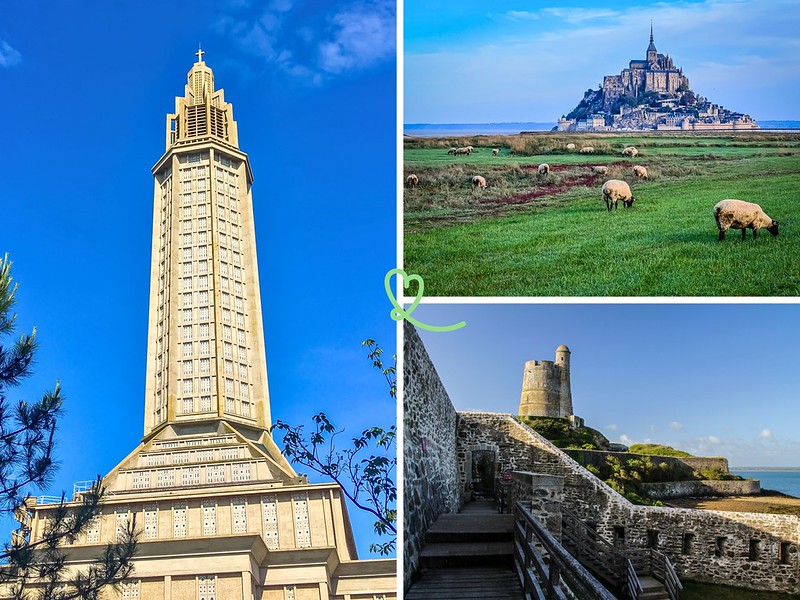
This guide is completely independent, based on our experiences. We visited the region anonymously, making our own choices and paying our bills in full.
The 7 UNESCO Sites in Normandy: Map
These seven sites were designated between 1979 and 2026 and fall under different UNESCO categories: World Heritage (cultural), Intangible Cultural Heritage, the Memory of the World Register, and the Global Geoparks Network. It is this diversity of historical statuses that makes up the region’s rich cultural heritage.
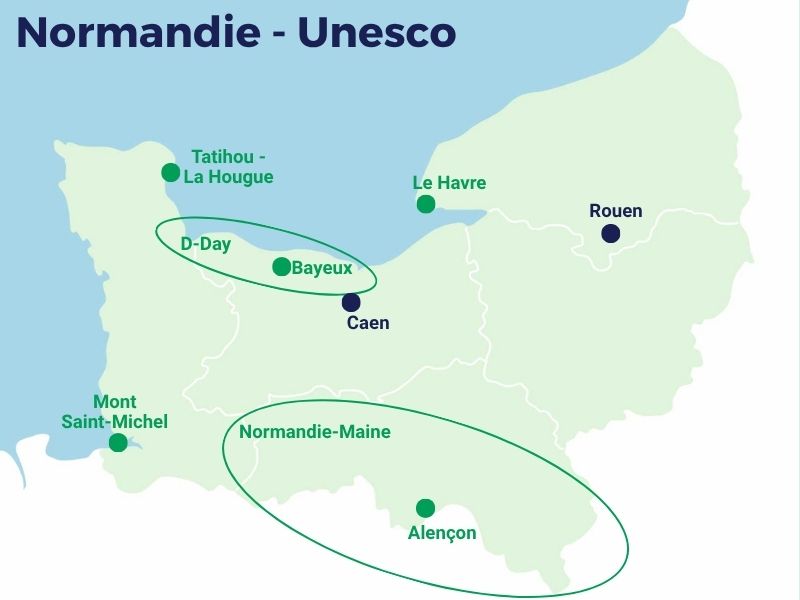
Here is the list of the 7 heritage sites, in the order in which they were designated:
- Mont-Saint-Michel and Its Bay (1979)
- Le Havre, the City Rebuilt by Auguste Perret (2005)
- The Vauban Towers of Tatihou and La Hougue (2008)
- The Art of Alençon Lace-Making (2010)
- The Bayeux Tapestry (Memory of the World)
- UNESCO Normandy-Maine Global Geopark (2024)
- D-Day Beaches, Normandy 1944 (2026)
OUR ADVICE FOR RENTING A CAR IN Normandy
- Compare prices on our preferred platform: DiscoverCars – one of the best rated sites.
- Choose a car that is comfortable enough (distances can be long) but compact (some parking lots and villages are narrow).
- Remember to take outcomprehensive insurance (some roads are winding and narrow).
- There is a lot of demand, book it early.

1. Mont-Saint-Michel and its bay
Why This Site Is Worth a Visit

Mont-Saint-Michel is undoubtedly Normandy’s most iconic site and one of the best-preserved monastic complexes in Europe. Founded in the 8th century, the abbey grew over the course of nearly a millennium on a rocky islet battered by one of the strongest tides in Europe. We were captivated by the silhouette of the mountain emerging from the bay as the tides rose and fell—a panorama that literally changes from hour to hour.
The designated site is not limited to the abbey: it encompasses the entire bay, its shores, its polders, and its surrounding islets, which illustrates just how inseparable Le Mont is from both its natural environment and its religious architecture.

Our Favorite Items
- All the views of this unique place
- The abbey’s cloister, suspended between the sky and the sea— be sure to reserve your time slot
- The village’s ramparts and narrow streets, which are especially peaceful early in the morning
- The striking contrast between high tide, which isolates the mountain, and low tide, which reveals kilometers of beach
- Explore it at night, after the tourists have left
- See our guide to visiting Mont-Saint-Michel

Location and How to Get There
- On the border between the Manche and Brittany
- From Caen = 1 hour and 15 minutes by car
- From Rennes = 1-hour drive
- Access to the mountain is only on foot or by shuttle from the parking lots
Why is this a UNESCO site?
- UNESCO Site 80
- Site type: cultural, inscribed in 1979
- Principal criterion: The abbey and its village constitute a masterpiece of human creative genius, remarkable for its integration into the exceptional natural setting of the bay
WHERE TO STAY IN Normandy
We particularly appreciate staying in Normandy:
- Bayeux – our hotels selection
- Honfleur – our hotel selection

For more ideas, take a look at our article on the best places to stay in Normandy.
And if you already have an idea, take a look at our selections:
2. Le Havre, the City Rebuilt by Auguste Perret
Why This Site Is Worth a Visit

More than 80% of Le Havre was destroyed by the bombings of 1944, and the city was completely rebuilt between 1945 and 1964 under the direction of architect Auguste Perret. We were struck by the coherence of this postwar urban planning: a regular grid, uniform building heights, prefabricated concrete facades, and major thoroughfares that give structure to the entire rebuilt downtown area.
Unlike other cities that were rebuilt after the war in a more haphazard manner, Le Havre exhibits a rare unity of design, conceived from the outset as a coherent whole rather than as a collection of separate projects.
Our Favorite Items
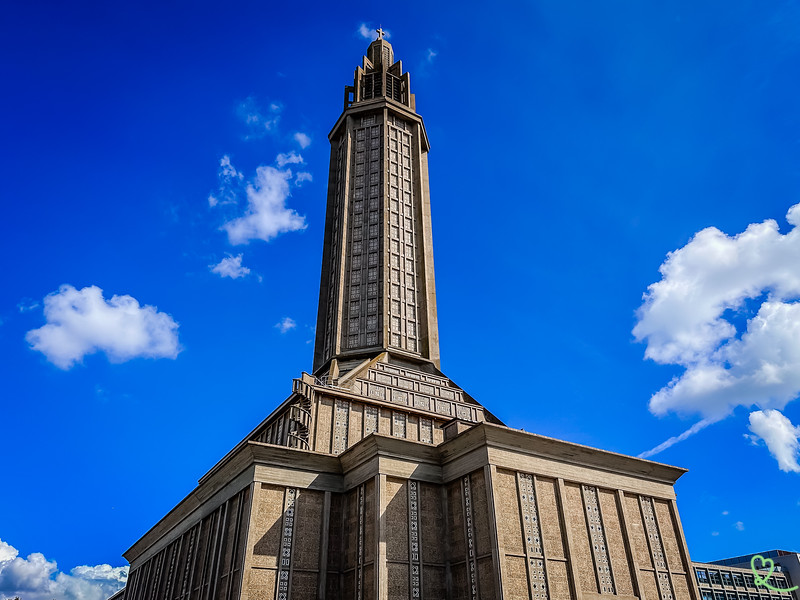
- St. Joseph’s Church, with its lantern tower and colorful stained-glass windows
- City Hall and its belfry, a landmark in the rebuilt downtown area
- A view of Avenue Foch, one of the major thoroughfares envisioned by Perret
- Show homes that let you experience a period-style interior
- See all attractions in Le Havre

Location and How to Get There
- On the Seine Estuary, in Seine-Maritime
- From Rouen = 1-hour drive
- From Caen = 1-hour drive
- The rebuilt downtown area is accessible on foot or by tram from the train station
Why is this a UNESCO site?
- UNESCO Site 1181
- Site type: cultural, inscribed in 2005
- Outstanding Universal Value: The rebuilt city center is an exceptional example of postwar architecture and urban planning, characterized by a unity of design that was rare for the time
3. The Vauban Towers of Tatihou and La Hougue
Why This Site Is Worth a Visit

Built in the late 17th century by Vauban following the naval defeat at La Hougue, these two twin towers guard the entrance to the port of Saint-Vaast-la-Hougue—one on the islet of Tatihou, the other on the Pointe de la Hougue. We appreciated the simplicity of these structures, designed first and foremost for their defensive effectiveness rather than for their grandeur.
They are one of the twelve French components of the serial property “Vauban Fortifications,” which brings together the finest examples of military architecture by the greatest military engineer of his time.

Our Favorite Items
- How the bay’s appearance changes between high tide and low tide as you approach Tatihou Island
- The view between the two towers, designed to complement each other
- The island’s botanical garden, sheltered from the wind by the ramparts

Location and How to Get There
- East coast of the Cotentin Peninsula, in the Manche department
- From Cherbourg = 45-minute drive
- From Caen = 1 hour and 30 minutes by car
- Access to Tatihou by amphibious boat from Saint-Vaast, or on foot at low tide
Why is this a UNESCO site?
- UNESCO Site 1283
- Site type: cultural, serial (12 French components), inscribed in 2008
- Primary criterion: The towers exemplify the pinnacle of classical fortification architecture and Vauban’s ingenuity in adapting to the terrain and maritime threats
4. The Art of Alençon Lace-Making
Why This Site Is Worth a Visit
Alençon lace is a needle lace technique that originated in the 17th century and is renowned for its delicacy and complexity. We were impressed to learn that mastering this craft traditionally takes several years of apprenticeship, with each piece requiring dozens, and sometimes hundreds, of hours of work.

Unlike the other sites on our list, this isn’t a place you visit in the literal sense, but rather a living craft passed down from generation to generation, now carried on by just a handful of lace makers.
But there’s a lace museum in the city of Alençon.
Why is this a UNESCO site?
- Intangible Cultural Heritage 00438
- Type of designation: intangible cultural heritage, inscribed in 2010
- Primary criterion: This craftsmanship reflects a rare and endangered technique, the transmission of which depends on a long and demanding apprenticeship.
5. The Bayeux Tapestry

Why This Site Is Worth a Visit
Created in the late 11th century, the Bayeux Tapestry depicts the conquest of England by William the Conqueror in 1066. We found it remarkable that, despite its name, it is in fact an embroidered piece, and that its length of some 70 meters makes it one of the few narrative works of this scale to have survived from the Middle Ages.
By viewing the frieze scene by scene, you can follow the story as if it were a medieval comic strip, from the preparations for the expedition to the Battle of Hastings.

Our Favorite Items
- The scene of the Battle of Hastings, the one with the most details and characters
- The upper and lower borders, adorned with animal scenes and fables
- The audio guide that lets you follow the story without getting lost in the details
- The associated museum, which provides a deeper understanding of the artwork and the history surrounding it
- Read more in our article

Location and How to Get There
- City of Bayeux
- From Caen = 30-minute drive
- A museum located in the city center, within walking distance of the train station
- Please note: The tapestry will be on display at the British Museum from September 10, 2026, to July 11, 2027, as part of a special loan.
Why is this a UNESCO site?
- Memory of the World
- Type of recognition: UNESCO Memory of the World Register
- Primary criterion: This textile document is a unique historical and artistic artifact, one of the few complete narrative accounts preserved from the 11th century
HAVE FUN WITH THESE activities in Normandy
- Helicopter flight over the cliffs of the Côte d’Albâtre
- Book your time to visit Mont-Saint-Michel Abbey
- Take a microlight flight over Mont-Saint-Michel
- Climb the Via Ferrata in Switzerland Normandy

6. UNESCO Global Geopark Normandy-Maine

Why This Site Is Worth a Visit
Designated in 2024, the UNESCO Normandy-Maine Global Geopark covers a vast area spanning the Orne department and part of the Pays de la Loire region. Unlike the other sites on our list, this is where geology takes precedence over human history: the landscape tells the story of some 600 million years of Earth’s history through its hills, steep-sided valleys, and rock outcrops.

Our Favorite Items
- Rock outcrops that bear witness to hundreds of millions of years of erosion
- The steep-walled valleys, ideal for hiking
- The Normandy bocage, typical of the region
- The many villages, abbeys, and castles. Don’t miss Saint-Cénéri-le-Gérei!

Location and How to Get There
- Southern Orne, straddling the Pays de la Loire region
- It is a vast, rural area, so a vehicle is necessary to explore its various sites
Why is this a UNESCO site?
- UNESCO Geopark
- Type of designation: UNESCO Global Geopark, designated in 2024
- Primary criterion: The area features a remarkable geological heritage, combined with sustainable management and educational initiatives to promote the area
7. D-Day Beaches, Normandy 1944

Why This Site Is Worth a Visit
Listed as a World Heritage Site in July 2026, after nearly twenty years of efforts, the D-Day beaches stretch for more than 80 kilometers along the coast between the English Channel and Calvados. It encompasses six distinct locations: Utah Beach, Omaha Beach, Gold Beach, Juno Beach, Sword Beach, and Pointe du Hoc.
Unlike the other sites on our list, this is first and foremost a place of remembrance: the designation recognizes the universal significance of June 6, 1944, as a symbol of the struggle for freedom, rather than the beauty of a monument or landscape.

Our Favorite Items
- Pointe du Hoc, with its shell craters still visible in the landscape
- Omaha Beach, the largest of the beaches and the one steeped in the most history
- The military cemeteries scattered along the coastline
- The contrast between the beaches’ current tranquility and the intensity of the events of 1944
- Learn more about the D-Day beaches, museums, and other sites worth visiting

Location and How to Get There
- From Caen = between 30 minutes and 1 hour by car, depending on the beach
- The six sites are spread out, so plan to use a car to travel between them during the day
- Beaches that remain freely accessible despite their classification
Why is this a UNESCO site?
- UNESCO Site 1581
- Site type: cultural, serial (6 components), inscribed in 2026
- Principal criterion: The site was the scene of a confrontation of exceptional magnitude in history and has become a place where people gather around a universal message of peace and freedom

It’s time to book!
Compare everything: companies, prices, schedules and availability.
One to watch: the La Hague Geopark
An application for UNESCO Global Geopark status has been submitted for La Hague, in the Manche department. The most recent UNESCO documents still refer to this project as a pending nomination; it has not yet been inscribed. If the proposal is approved, Normandy would have its eighth UNESCO-recognized site.

Frequently asked questions
How many UNESCO sites are there in Normandy?
Normandy is home to seven UNESCO-recognized sites: Mont-Saint-Michel and its bay, Le Havre, rebuilt by Auguste Perret; the Vauban towers at Tatihou and La Hougue; the craftsmanship of Alençon lace; the Bayeux Tapestry; the Normandy-Maine Global Geopark; and the D-Day Beaches, Normandy 1944.
Which UNESCO site should you visit first in Normandy?
It depends on your interests. When it comes to medieval architecture, Mont-Saint-Michel remains a must-see. When it comes to 20th-century history, the D-Day beaches are a must-see. When it comes to modernist architecture, Le Havre offers an experience unlike any other in France. We recommend, weather permitting, visiting at least one historic site and one memorial site.
PLAN YOUR TRIP TO Normandy
Inspiration destinations
- Deciding where to go in Normandy – the best destinations
- Our weekend ideas: best-of, romantic, unusual, seaside, luxury, family
- 16 seaside hotels in Normandy
- The most beautiful charming hotels in Normandy

Best of

Practice
- Where to stay in Normandy – best places and hotels
- See our tips for renting a car at CDG airport, Orly airport, Beauvais airport, Caen, Rouen, Bayeux…