
Want to leave enough time to discover the region’s most beautiful places?
Here’s our advice on how many days to spend in Normandy, according to your expectations.
This guide is completely independent, based on our experiences. We visited the region anonymously, making our own choices and paying our bills in full.
How many days to spend in Normandy: quick answers
- Minimum to get an overview of the region: 1 week
- Number of days to see all the most famous places: 10 days
- Ideal number of days to really enjoy it, in our opinion: 2 to 3 weeks
- If you just want to spend some time on the beach… it depends on the number of days you have available and your budget.
There is no universal answer to this question. It depends on a number of criteria. We give you more details in the article to help you make your decision.
Normandy is a vast and rich region. It covers several départements with very different landscapes: chalk cliffs, hedged farmland, D-Day beaches, historic towns and fishing ports. The amount of time you’ll need depends on the areas you wish to explore.

Number of days to see the highlights
In our opinion, the must-see places are..:
- Mont-Saint-Michel and its bay
- The cliffs of Étretat
- One of the D-Day landing beaches (Omaha Beach, Utah Beach…)
- The historic city of Rouen and its cathedral
- Honfleur and its harbour
- Bayeux and its famous tapestry (an 11th-century, 70m-long embroidery depicting the conquest of England by William the Conqueror, Duke of Normandy)
- Deauville and its beaches
- Claude Monet’s gardens at Giverny (French Impressionist painter, famous for his water lilies)
- Pays d’Auge and its half-timbered villages
We think that with a minimum of 10 days, you can cover the most famous places, provided you stay in two different bases (for example, the north coast around Étretat, then the west coast around Bayeux) or ideally do a road trip changing every night.

WHERE TO STAY IN Normandy
We particularly appreciate staying in Normandy:
- Bayeux – our hotels selection
- Honfleur – our hotel selection

For more ideas, take a look at our article on the best places to stay in Normandy.
And if you already have an idea, take a look at our selections:
Size and travel time
Normandy is a vast region. From east to west, the distance between Giverny and Mont-Saint-Michel is around 3h30 (350km). This makes it difficult to see everything from a single vantage point.
We recommend dividing your stay into two or three bases to limit the need for long daily journeys. Here are a few indicative driving times:
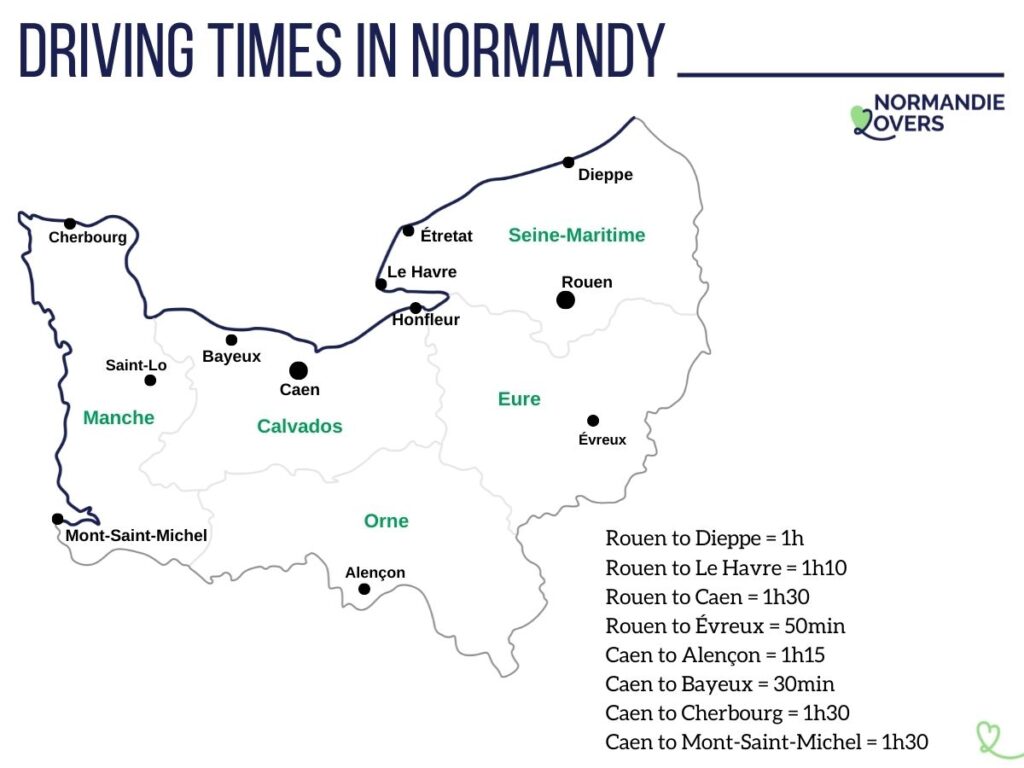
The car is the most practical way to explore Normandy, as many sites are far from train stations. There are some train connections (Paris-Rouen, Paris-Caen, Caen-Bayeux), but public transport to the cliffs of Étretat, the D-Day landing beaches or the Pays d’Auge is limited.
OUR ADVICE FOR RENTING A CAR IN Normandy
- Compare prices on our preferred platform: DiscoverCars – one of the best rated sites.
- Choose a car that is comfortable enough (distances can be long) but compact (some parking lots and villages are narrow).
- Remember to take outcomprehensive insurance (some roads are winding and narrow).
- There is a lot of demand, book it early.

What you can see depending on the number of days
3 days in Normandy
In 3 days, you can discover part of Normandy, but you’ll have to make a choice. You have two options: concentrate on the Côte d’Albâtre (Étretat, Rouen, Honfleur) or on the western sector (D-Day beaches, Bayeux, Mont-Saint-Michel). We strongly advise against combining everything in such a short time, as the distances are vast and the pace too fast.
1 week in Normandy
With 1 week, you can cover the main highlights while maintaining a good pace. It’s enough to combine Étretat, Honfleur, the D-Day landing beaches, Bayeux and Mont-Saint-Michel. We recommend you plan two bases: one or two nights around Honfleur, then two or three nights near Bayeux. On the other hand, there will be little time left for Rouen, Giverny or the Pays d’Auge.

10 days in Normandy
10 days is a good compromise for discovering the essentials. You can visit Rouen, Étretat, Honfleur, Deauville, the D-Day landing beaches, Giverny, Bayeux and Mont-Saint-Michel at a leisurely pace. We advise you to plan two or three accommodation bases to avoid spending too much time in the car. You can also include a half-day of relaxation or an excursion in the Pays d’Auge.
2 weeks in Normandy
It’s the ideal length of time to explore Normandy in depth. In addition to these must-sees, you can also visit the Suisse Normande, the Cotentin peninsula, the Pays d’Auge, Granville or the Côte d’Albâtre in greater depth. This time also allows you to enjoy the local gastronomy, visit cheese dairies and cider mills and stroll through the markets.

3 weeks in Normandy
With 3 weeks, you can really get to know every corner of the region. The options are vast, so here are our picks to help you choose:
- Most beautiful villages
- Most beautiful cities
- Most beautiful castles
- Most beautiful abbeys
- Most beautiful beaches
- Most beautiful cathedrals and churches
- Best museums
- Most beautiful destinations
- Most beautiful landscapes

Criteria for deciding how long to spend in Normandy
Budget
Evaluate how much you can afford in total, to help you define the possible length of your stay.
Normandy offers a wide range of prices. Accommodation prices vary greatly according to season and location: seaside resorts like Deauville or Honfleur are more expensive than the hinterland.
In the countryside, you’ll find bed & breakfasts and gites at lower prices.
Your desires, interests and goals
Beaches and seaside resorts? History and memory? Gastronomy? Hiking? Your desires have a direct impact on the time you need to enjoy your destination. P
Normandy is a very complete region. Among other things, it offers:
- Historic sites: D-Day beaches, World War II museums, medieval towns, abbeys, castles
- Cultural sites: museums, cathedrals, Bayeux Tapestry, Monet Gardens, writers’ houses
- Beautiful towns and villages
- Beautiful beaches: some with flat pages, others with pebbles and cliffs
- Hiking: coastal paths, GR21 along the cliffs, Suisse Normande
- Gastronomy

Visa
France is part of the Schengen area. If your passport is issued by a country outside the Schengen area, the classic tourist visa authorizes you to stay for a maximum of 90 days within a 180-day period in the entire Schengen zone.
Weather, conditions, events, closures
The weather can influence your stay in Normandy. The region is known for its oceanic climate, which means frequent showers, even in summer. We recommend you bring a waterproof jacket whatever the season.
A few points to bear in mind:
- Summer (June to August): the most pleasant period for sightseeing and beaches, but also the busiest. Temperatures fluctuate between 18 and 25°C. Accommodation is often fully booked, especially on the coast.
- Spring (April-May): ideal time for Giverny gardens (open from April to October) and cultural visits. The weather is variable but the crowds are smaller.
- Autumn (September-October): beautiful colors, lower prices and a calmer atmosphere. It’s also the season for apples, new cider and mussels.
- Winter (November to March): some tourist sites reduce their opening hours or close (Monet’s Gardens close from November to March, most D-Day museums close in January). However, Mont-Saint-Michel and the towns remain accessible. The high winter tides in the Bay of Mont-Saint-Michel are a breathtaking sight.
Please note: June 6 is the date on which the D-Day landings are commemorated. The ceremonies attract many visitors to the beaches and surrounding towns. If you plan to visit the D-Day landing sites at this time, book your accommodation well in advance.
See our article: When to go to Normandy.

Practical information
How to get to Normandy
Normandy is easily accessible from Paris. The train links Paris-Saint-Lazare to Rouen in 1h20, Caen in 2h and Bayeux in 2h30. Direct connections also exist from other major French cities.
See available timetables and book your train and coach tickets now.
By car from Paris, allow around 2 hours for Giverny or Rouen, 2h30 for Honfleur (via the Pont de Normandie) and 3h for Caen. The A13 and A84 freeways serve the region well.
For international travelers, the nearest airports are Paris-CDG and Paris-Orly. Deauville-Normandie airport offers some seasonal connections. From the UK, ferries link Portsmouth to Caen-Ouistreham and Dieppe to Newhaven.

It’s time to book!
Compare everything: companies, prices, schedules and availability.
Getting around Normandy
The car remains the most practical way to visit Normandy. The major sites are scattered over a wide area, and public transport, although available between the major towns, does not easily serve the cliffs of Étretat, the D-Day landing beaches or the villages of the Pays d’Auge.
For those who don’t drive, organized excursions from Bayeux or Caen cover the D-Day landing beaches. Seasonal shuttles also run to Mont-Saint-Michel from nearby stations (Pontorson, Dol-de-Bretagne). We do, however, recommend a car for flexible exploration of the region.

Where to stay
For a 3-5 day stay, one or two bases are sufficient. For a stay of 7 days or more, we recommend three bases to cover the region without too much driving:
- East base: Rouen or Étretat, for the Côte d’Albâtre and the Seine valley.
- Central base: Honfleur, Deauville or Cabourg, for the Côte Fleurie and Pays d’Auge regions.
- Western base: Bayeux, for the D-Day landing beaches and Mont-Saint-Michel
WHERE TO STAY IN Normandy
We particularly appreciate staying in Normandy:
- Bayeux – our hotels selection
- Honfleur – our hotel selection
For more ideas, take a look at our article on the best places to stay in Normandy.
And if you already have an idea, take a look at our selections:
Frequently asked questions
Is 3 days enough in Normandy?
In 3 days, you can discover a small part of Normandy, but not all of it. Choose between the Côte d’Albâtre (Étretat, Honfleur, Rouen) or the western sector (D-Day beaches, Bayeux, Mont-Saint-Michel). This short stay is ideal for a first overview.
Can you visit Normandy without a car?
It’s possible, but more restrictive. The major towns (Rouen, Caen, Bayeux) are accessible by train. On the other hand, the cliffs of Étretat, the D-Day beaches and the Pays d’Auge are difficult to reach by public transport. There are organized excursions from Bayeux and Caen to the D-Day landing sites. We still recommend the car for a flexible visit.
When is the best time to visit Normandy?
The period from May to September offers the best conditions for exploring the region. Summer is the most popular season, but spring and early autumn offer a good compromise between pleasant weather and fewer visitors. In winter, some sites reduce their opening hours, notably the Jardins de Monet, which closes from November to March.
PLAN YOUR TRIP TO Normandy
Inspiration destinations
- Deciding where to go in Normandy – the best destinations
- Our weekend ideas: best-of, romantic, unusual, seaside, luxury, family
- 16 seaside hotels in Normandy
- The most beautiful charming hotels in Normandy
Best of
Practice
- Where to stay in Normandy – best places and hotels
- See our tips for renting a car at CDG airport, Orly airport, Beauvais airport, Caen, Rouen, Bayeux…