
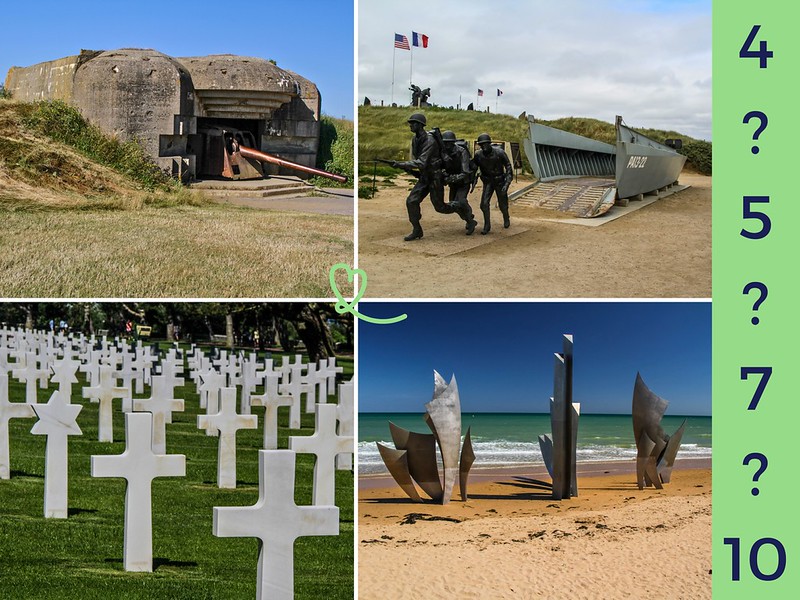
On June 6, 1944, Allied troops landed on five beaches stretching nearly 80 km along the Normandy coast. It’s hard to know how many days to set aside for Utah Beach, Omaha Beach, Gold Beach, Juno Beach, and Sword Beach: for some, one beach is enough, while others want to explore them all thoroughly. We ‘ll help you choose the duration that best suits your needs, from a brief overview to a full tour.
This guide is completely independent, based on our experiences. We visited the region anonymously, making our own choices and paying our bills in full.
How Many Days to Visit the D-Day Beaches: Quick Answers
- To see just one beach and come away with a memorable image: half a day
- For a tour of the D-Day landings at one of the beaches (a beach, a museum, a battery, and a cemetery): 1 day
- To see the 5 D-Day beaches without spending too much time at each one: 3 days
- To fully explore the five beaches, as well as the museums, fortifications, and cemeteries associated with them, we recommend: 5 days to a week

There is no single answer to this question. It all depends on your interest in military history, how much time you have, and whether or not there are children in the group. We’ll go into detail about each option later in this article.
Travel time between the beaches
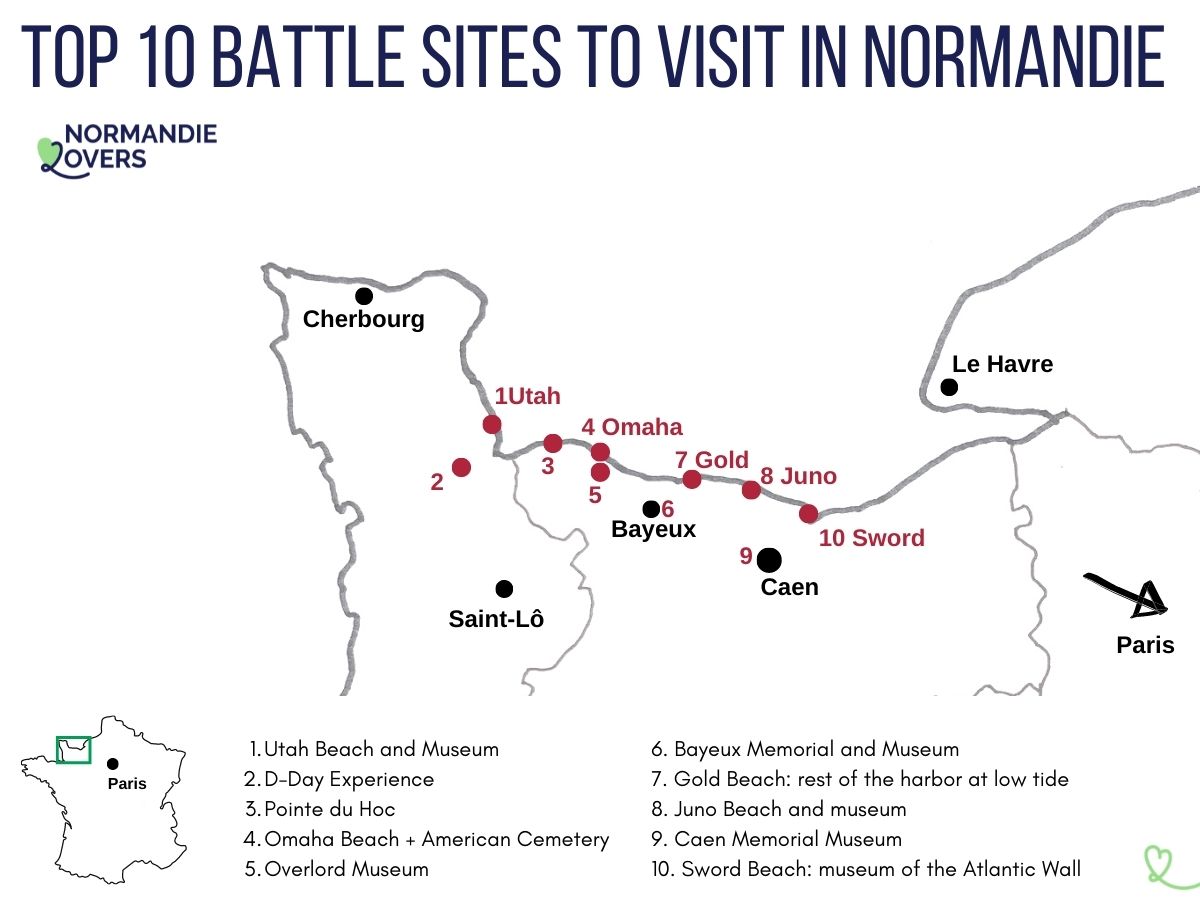
The five beaches stretch along nearly 80 km of coastline, from Utah Beach in the northwest to Sword Beach in the northeast. Allow about 1 hour for the drive between the two ends, via Bayeux or Caen. The distances are manageable in a single day if you limit the number of stops, but they add up quickly once you start visiting multiple museums and cemeteries at each stop.
OUR ADVICE FOR RENTING A CAR IN Normandy
- Compare prices on our preferred platform: DiscoverCars – one of the best rated sites.
- Choose a car that is comfortable enough (distances can be long) but compact (some parking lots and villages are narrow).
- Remember to take outcomprehensive insurance (some roads are winding and narrow).
- There is a lot of demand, book it early.

Just one beach to visit: which one should you choose?
If time is limited and only one track can be included in the program, the choice depends mainly on the desired profile.
- Gold Beach, near Arromanches-les-Bains, remains the most striking: at low tide, the concrete blocks of the Mulberry artificial harbor emerge from the water, offering a concrete sense of the scale of the Allied logistical operation.
- Omaha Beach, for its part, has a cemetery, a museum, and a battery all located in the immediate vicinity, which allows visitors to understand the event in its context without having to make multiple trips.
- Juno Beach is a good choice for those following in the footsteps of Canadians,
- Sword Beach is of greater interest to visitors who are interested in the British perspective and the Pegasus Bridge.

Gold Beach is our first choice, but you have to be able to go there at low tide.
We often recommend Omaha Beach to anyone who can only check off one beach on their list. The beach itself is quiet, almost silent, but the American Cemetery at Colleville-sur-Mer, the Overlord Museum, and Pointe du Hoc are all less than a 30-minute drive away. We have noticed that few other sectors have so many complementary sites concentrated within such a small area. Allow half a day for the beach alone, or a full day if you include the cemetery and the museum.

For a one-day tour: a beach, a museum, a fort, and a cemetery
To get a good overview of the D-Day landings without spending several days there, combine these four types of sites into a single day. Here are 4 possible combinations, depending on which angle interests you the most:
- General view:
the Caen Memorial Museum to provide some context, followed by Juno Beach, the Merville Battery, and the Canadian Cemetery at Beny-sur-Mer - Field of view:
Gold Beach at low tide in Arromanches-les-Bains, the Arromanches D-Day Museum, the Longues-sur-Mer Battery, and the British cemetery in Bayeux - American angle:
Omaha Beach, the Overlord Museum, Pointe du Hoc, and the American Cemetery at Colleville-sur-Mer - Airborne angle:
Utah Beach, the Airborne Museum in Sainte-Mère-Église, the Azeville Battery, and the German cemetery at La Cambe, on the way back
Find more details about each of these museums in our article on the best D-Day museums, and about the gun batteries in our article on the best German gun batteries in Normandy.

STAYING NEAR THE D-Day beaches
Option 1: Bayeux
The most practical option, in our opinion, is to base ourselves in the town of Bayeux. We recommend..:
- Hotel Domaine de Bayeux in an 18th century mansion – see prices, photos and availability
- see all top rated accommodations in Bayeux

Option 2: in the countryside
In the countryside around the D-Day beaches, you will find beautiful buildings with a lot of charm: farms, manors…
- Domaine d’Utah Beach Hotel – see prices, photos and availability
- Hotel Ferme de la Rançonnière – prices, pictures and availability

Option 3: next to one of the beaches
If you’re looking for a seaside holiday or are fascinated by one of the beaches, you can choose a more specific hotel:
- Villas d’Arromanches Hotel in Gold Beach – see prices, photos and availability
- La Sapinière Hotel in Omaha Beach – see prices, photos and availability

The 5 D-Day Beaches, Beach by Beach
Here are the 5 beaches in detail, shown in relation to their nearest complementary sites. Find even more practical information in our article dedicated to the D-Day beaches.
Utah Beach

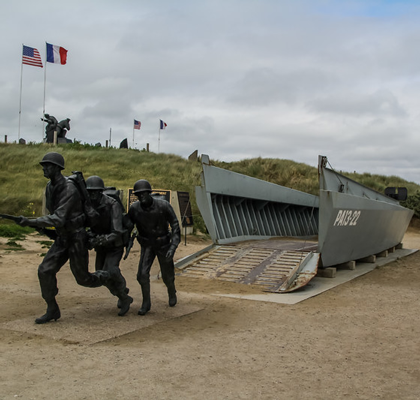
Utah Beach stretches from Sainte-Marie-du-Mont to Quinéville, on the east coast of the Cotentin Peninsula. The sector was one of two American landing zones, along with Omaha, and paratroopers landed there even before dawn on June 6, 1944. The fine sand and dunes are now home to memorials, statues, and a museum built directly on top of a former German bunker. We enjoyed the contrast between the beach’s current tranquility and the intensity of the exhibits at the nearby museum.
- We recommend setting aside half a day if you’re sticking to the beach and the museum, or a full day if you include the Airborne Museum and the Azeville Battery.
- Travel time from Caen: 1 hour
- Driving time from Bayeux: 50min
- On site: the D-Day Museum at Utah Beach
- Nearby: the Azeville Battery (15 minutes from the museum), the Airborne Museum in Sainte-Mère-Église (45 minutes from Bayeux), and the Normandy Victory Museum in Carentan-les-Marais (40 minutes from Bayeux)
- Learn more about Utah Beach
Omaha Beach

Omaha Beach is a long stretch of sand, accessible from several villages perched atop the cliffs. This area became a deadly trap for Allied troops, who suffered heavy losses here on D-Day. A memorial stands in the middle of the sand, and the Overlord Museum is just a few minutes’ drive away, in Colleville-sur-Mer. We consider this beach to be the most emotionally charged in the area, especially when combined with a visit to the nearby American cemetery.
- We recommend setting aside a full day for this beach-museum-cemetery tour.
- Driving time from Caen: 40min
- Travel time from Bayeux: 25 min
- On site: memorial in the sand, Overlord Museum in Colleville-sur-Mer
- Nearby: the American Cemetery at Colleville-sur-Mer (9,385 graves), Pointe du Hoc (35 minutes from Bayeux), and the Longues-sur-Mer Battery (15 minutes from Bayeux)
- Learn more about Omaha Beach
Gold Beach (Arromanches-les-Bains)

Gold Beach is the beach at Arromanches-les-Bains, where British troops landed to liberate Bayeux. It was here that the Mulberry artificial harbor, nicknamed Port Winston, was towed from Great Britain in June 1944 to unload military supplies. At low tide, large concrete blocks are still visible around the beach and in the water, giving a clear sense of the scale of the construction project. We consider this site to be one of the most spectacular in the area thanks to these ruins, which are visible to the naked eye.
- Plan on spending half a day just for the beach and the museum, or a full day if you want to include the cemetery and the battery as well
- We recommend checking the tide schedules before your visit so you can make the most of it.
- Driving time from Caen: 40min
- Driving time from Bayeux: 20min
- On site: ruins of Port Mulberry, a 360° cinema, and the Arromanches D-Day Museum
- Nearby: the Longues-sur-Mer Battery (20 minutes from Bayeux), the British Cemetery in Bayeux (in the town of Bayeux)
- Learn more about Gold Beach
Juno Beach

Juno Beach features a long sandy beach, backed by dunes. There, you’ll find a few tanks and bunkers, as well as the Cross of Lorraine, which marks the spot where General de Gaulle set foot in France after four years in exile. The Juno Beach Centre, located right on the beach, chronicles Canada’s contribution to the D-Day landings and to World War II as a whole—before, during, and after the conflict. We particularly appreciate this museum for its perspective, which is less well-known than the American or British accounts.
- Plan for half a day
- Driving time from Caen: 30min
- Driving time from Bayeux: 30min
- At the site: Cross of Lorraine, Juno Beach Center
- Nearby: the Canadian cemetery in Beny-sur-Mer (2,049 graves), and another Canadian cemetery in Bretteville-sur-Laize, south of Caen
- Learn more about Juno Beach
- Read our article to plan your visit to the Juno Beach Center
Sword Beach

Sword Beach stretches 8 km from Saint-Aubin-sur-Mer to Ouistreham. British troops landed there and were joined by French commandos tasked with capturing several strategic bridges, including the one that was renamed Pegasus Bridge after the operation. The beach at Ouistreham, which is very large and flat, bears few visible traces of the past, but the town is home to the Atlantic Wall Museum and the 4th Commando Museum. We recommend ending your tour at the Grand Bunker, located in the former German command center that controlled all the batteries in the area.
- Driving time from Caen: 20min
- Travel time from Bayeux: 40 min
- At the site: the Atlantic Wall Museum (Grand Bunker), the No. 4 Commando Museum
- Nearby: Pegasus Bridge, the Merville Battery
- Learn more about Sword Beach
Itineraries Based on the Length of Your Stay
Depending on how much time you have, there are several possible route options, ranging from a quick stop at a beach to a complete tour of all five sectors.
1 day
In one day, choose either a single beach combined with its nearby attractions (see the “One Beach to Visit” section above) or one of the four combinations suggested in the one-day overview.
2 days
- Day 1:
Utah Beach, the D-Day Museum, the Airborne Museum in Sainte-Mère-Église, then Omaha Beach, the American Cemetery, and the Overlord Museum - Day 2:
Gold Beach in Arromanches, the Arromanches D-Day Museum, Juno Beach and the Juno Beach Center, then Sword Beach and the Atlantic Wall Museum

3 days
Add the following batteries to the 2-day tour: Pointe du Hoc and the Longues-sur-Mer Battery near Omaha and Gold, the Merville Battery near Sword, and the Azeville Battery near Utah. The Caen Memorial Museum is also a good place to visit as a supplement, to provide some general context either before or after the beach tour.
5 days (the full tour)
- Day 1:
Caen Memorial, then on to Sword Beach (Ouistreham). Night in Ouistreham – see the best offers - Day 2:
The Atlantic Wall Museum, Juno Beach and its museum, then on to Gold Beach (Arromanches). Night in Arromanches – see the best offers - Day 3:
The Arromanches Museum and the beaches at low tide, the Longues-sur-Mer Battery, and then the Bayeux Museum. Night in Bayeux – see the best offers - Day 4:
Omaha Beach, American Cemetery, Overlord Museum, Pointe du Hoc. Overnight Stay in Sainte-Mère-Église – See the Best Deals - Day 5:
Sainte-Mère-Église, the Airborne Museum, and Utah Beach
This tour allows you to stay at a different hotel each night to minimize daily travel. If you prefer a single base, Bayeux or Caen work just as well, though the trips will be a little longer on some days.

Criteria for deciding how much time to spend at the D-Day landing sites
Your Interests and Preferences
A quick visit is enough for anyone who just wants to see the beaches and get a general idea of the D-Day landings. A more in-depth exploration—including the batteries and cemeteries—takes several days.
Family Trip
If you’re traveling with children, choose beaches that offer plenty of space to run around and feature visible military artifacts, such as Juno Beach and Utah Beach. Limit the number of museums you visit in a single day, and save the most immersive exhibits—such as the one at the Normandy Victory Museum—for older children, depending on their sensitivity.
Budget
Car rentals and hotel stays put a strain on the budget for a multi-day trip. Compare prices on our favorite car rental platform, and keep in mind that some museums, such as the Batterie d’Azeville, charge an admission fee (€8, €4 for children).

Personal circumstances
Take into account your own schedule, including work commitments and personal responsibilities. This will help you realistically estimate how much time you can spend on this tour.
Weather and Tides
Tide schedules have a significant impact on a visit to Gold Beach: the remains of Mulberry Harbor are best seen at low tide. Check the schedules before you leave, no matter what season you choose.

MORE ABOUT THE D-Day sites
- The best landing sites to visit
- Visit the 5 D-Day landing beaches
- Where to stay – best hotels near the beach
- The best D-Day museums in Normandy
- German batteries to visit
- Car rental tips: Caen – Roissy-CDG – Orly – Beauvais
- Visit Omaha Beach
- Visit Utah Beach
- Visit Gold Beach
- Visit Sword Beach
- Visit Juno Beach (coming soon)
Frequently asked questions
Is one day enough to visit the D-Day beaches?
In one day, you can visit a beach along with a museum, a battery, and a cemetery, but you won’t be able to explore all five beaches in depth. If you want to get a glimpse of the five beaches without spending too much time at each one, plan on spending about two days.
Which D-Day beach is the most impressive?
It depends on the type of candidate we’re looking for. Gold Beach in Arromanches remains the most striking sight, thanks to the remains of the Mulberry Harbor that are visible at low tide. Omaha Beach has the highest concentration of related sites in the immediate vicinity.
Do you need a car to visit the D-Day beaches?
A car is still the most convenient way to get from one beach to another at your own pace. Organized tours are also available from Paris, Caen, or Bayeux for those who prefer not to drive— see the options.
Is 5 days too long to visit the D-Day landing beaches?
No, five days are enough to thoroughly explore all five beaches, as well as the museums, fortifications, and cemeteries associated with each one, without having to rush from one day to the next.
PLAN YOUR TRIP TO Normandy
Inspiration destinations
- Deciding where to go in Normandy – the best destinations
- Our weekend ideas: best-of, romantic, unusual, seaside, luxury, family
- 16 seaside hotels in Normandy
- The most beautiful charming hotels in Normandy

Best of

Practice
- Where to stay in Normandy – best places and hotels
- See our tips for renting a car at CDG airport, Orly airport, Beauvais airport, Caen, Rouen, Bayeux…