
Welcome to the enchanting world of Norman cheeses, where centuries-old cheese-making traditions combine with a rich and diverse terroir. From the gentle Seine valley to the windswept coasts around Mont-Saint-Michel, Normandy offers magnificent landscapes and a feast of exceptional cheeses.
In this article, we list not only the four AOP (protected designation of origin) cheeses, but also our favorite Normandy cheeses.
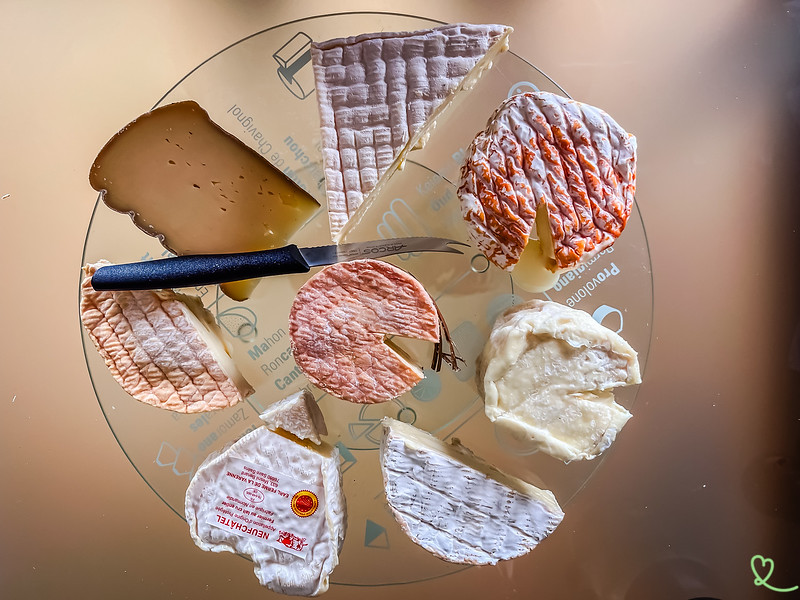
Normandy cheeses: PDO and more!
How many cheeses in Normandy
There are countless cheeses from Normandy, because the producers are so creative. But if we limit ourselves to cheeses with Protected Designation of Origin status, there are 4 PDO cheeses in Normandy.
We list all our favorite cheeses in this article, but here are some quick answers in the meantime.

The 4 Normandy PDO (Protected Designation of Origin) cheeses are:
- Camembert de Normandie
- The Livarot
- Visit Pont-l’Évêque
- The Neufchatel
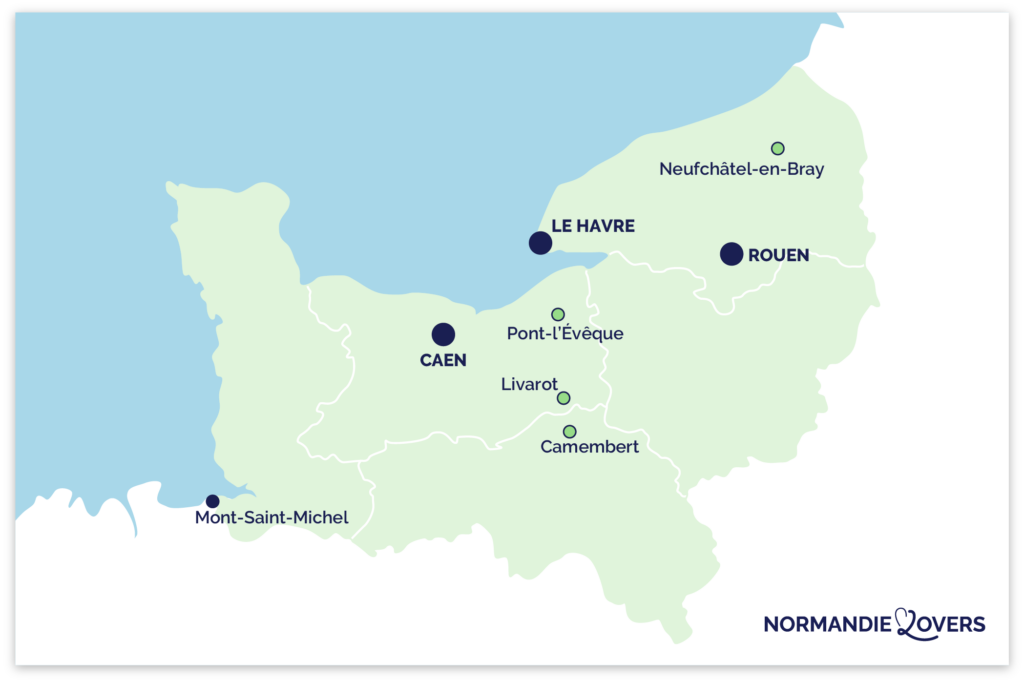
Here are the villages of origin of these cheeses. But the manufacturing zones are fairly extensive in Normandy.
The world’s best-known French cheese
The best-known and most emblematic French cheese in the world is undoubtedly “Camembert”. Originally from Normandy, this soft cheese with a bloomy rind is famous for its creamy texture and delicate taste.

The 5 cheeses of Normandy
Sometimes you’ll see the “5 cheeses of Normandy” mentioned.
This list includes the 4 PDO cheeses and one lesser-known cheese:
- Camembert de Normandie
- The Livarot
- Visit Pont-l’Évêque
- The Neufchatel
- And Pavé d’Auge
Our favorites
If you had to try just one, we’d recommend a good Camembert.
However, we really do love them all.
- Clairetakes a small piece of each, but prefers camembert
- Manu: can’t decide between Neufchâtel and Pont-l’Évêque
- Eugénie: Neufchâtel, Neufchâtel and Neufchâtel
- Our mother: can’t decide between Pont-l’Évêque and Neufchâtel
- Our father: a slight preference for Pont-l’Évêque
1. Camembert de Normandie (PDO)
Description
Cow’s milk
Camembert is a soft cheese with a bloomy rind, characterized by its white, downy exterior and creamy interior. It is made from raw or pasteurized cow’s milk. But Camembert d’appellation contrôlée is made from raw milk. And that’s what we like best!
Pasteurized milk is heated to over 70 degrees Celsius during the cheese-making process, compared with 40 degrees for raw milk. Although pasteurized milk eliminates all health risks by killing all bacteria, it also has considerably less taste and ages less well.

Camembert’s rind, also known as the “flower”, is due to the presence of a fine white mold that develops naturally on the surface of the cheese. As Camembert ages, its rind may evolve, becoming more pronounced in flavor and texture.
The inside of the Camembert is soft, creamy and melts in the mouth. Its color ranges from off-white to pale yellow. Camembert’s flavors are often described as delicate, with notes of mushroom and butter, and a slight acidity that balances its richness.
Tasting advice
When enjoying a Camembert, we recommend serving it at room temperature, as this allows the aromas to develop fully. You can enjoy it simply on a piece of fresh bread, with a crusty baguette, fresh fruit, nuts or even jam.
The combination of the soft crust and creamy center is a delight to the palate!
We like to add camembert to lots of dishes, including a sauce for mussels! You’ll also find it on the menus of tapas restaurants and wine bars, just “roasted” or reheated in its own tin (to be eaten in moderation, but so good!).

Origin and village Camembert
The history of Camembert dates back to the 18th century, in the Normandy region of France. The cheese takes its name from the tiny village of Camembert, in the Orne department of France, where it is said to have been created for the first time. However, there are different versions of its creation.
One of the most famous versions is that Camembert was created by Marie Harel, a farmer from Normandy. She is said to have adapted the cheese recipe from the refractory priests who sought refuge during the French Revolution.

Camembert gained in popularity, and the construction of the French railway network in the 19th century played a crucial role in spreading Camembert throughout the country and beyond its borders.
The “Camembert de Normandie” Protected Designation of Origin (PDO) was officially recognized in 1983, establishing strict manufacturing standards to preserve the authenticity of the cheese: raw milk from Normandy cows, in the specific geographical region, and following traditional production methods.
2. Pont-l’Évêque (PDO)
Description
Cow’s milk
Pont-l’Évêque is a soft, washed-rind cheese. It is renowned for its square shape, orange rind and distinctive flavour.
During ripening, the rind is regularly washed with salt water, creating a favorable environment for the development of specific bacteria. This gives the crust an orange color and a slightly sticky texture. This is what sets it apart from other cheeses.

The inside of Pont-l’Évêque is soft and creamy, with a pale yellow hue. Flavours vary according to the maturity of the cheese. Younger versions have light, delicate aromas, while more mature cheeses can have stronger flavors and a more powerful aroma. We love it when Pont-l’Évêque is ripe (also known as “well done”). Delicious!
Tasting advice
Pont-l’Évêque is often eaten with a fresh baguette, fresh fruit such as apples or pears, and possibly nuts or dried fruit. It also pairs well with light red wines or Norman ciders.

Origin and town of Pont-l’Évêque
Like many French cheeses, Pont-l’Évêque has a long history dating back to the Middle Ages. Its manufacture has evolved over time, but traditional techniques and the use of whole cow’s milk have persisted to maintain the authenticity of the cheese.
This cheese takes its name from the town of Pont-l’Évêque, in the Calvados department. But the exact history of Pont-l’Évêque is a little more hazy and surrounded by legend. It is said to have been created by Benedictine monks in the 12th century, adapting Viking cheese-making techniques…

This cheese was awarded the Protected Designation of Origin (PDO) in 1972 to guarantee that it is made using traditional methods. The geographical protection zone was defined in 1996.
3. Neufchâtel (PDO)
Description
Cow’s milk
Neufchâtel is a soft cheese with a bloomy rind. This cheese is remarkable for its heart shape, although other shapes are also produced (bricks…). Neufchâtel is distinguished by its smooth, creamy texture and white rind. Its taste is mild and delicate.

Neufchâtel cheese is made from cow’s milk, usually raw but sometimes pasteurized. It is produced using traditional methods, involving coagulation of the milk, cutting of the curd, stirring and molding. After production, the cheese is matured for several weeks.
Tasting advice
Neufchâtel is versatile in the kitchen. It can be enjoyed fresh, simply spread on bread (as we love to do). It can also be used in culinary recipes, notably in sauces to accompany red or white meats. It goes well with fresh fruit, jam and honey, and can be accompanied by light white wines or Norman cider.

Origin and village of Neufchâtel en Bray
It is considered one of Normandy’s oldest cheeses. Its history is rich and legendary, steeped in local traditions and romantic tales. The precise origins of Neufchâtel date back to the Middle Ages, but historical details are difficult to establish with any certainty.
Legend has it that during the Hundred Years’ War (1337-1453), Norman women offered Neufchâtel hearts to English soldiers as a sign of love and support. This tradition is said to have helped shape the cheese’s characteristic heart shape. Neufchâtel was seen as a symbol of solidarity with English troops.

In 1969, Neufchâtel was awarded the Protected Designation of Origin (PDO), which means it is protected by strict rules and production standards to preserve its authenticity and link with the Normandy region.
4. Livarot (PDO)
Description
Cow’s milk
Livarot is a soft, washed-rind cheese. Recognizable by its cylindrical shape and surrounding circles of woven straw. The interior of Livarot is supple, creamy and often marked by a powerful, characteristic aroma.

Its washed rind is one of its most striking features. During ripening, the rind is regularly washed with salt water, or sometimes with cider or calvados, which encourages the development of specific bacteria and gives the rind an orange to brownish color and a sticky texture.
Livarot’s flavors offer notes of mushroom, hazelnut and sometimes a hint of spiciness, depending on its degree of ripeness. The more mature the cheese, the more pronounced its flavors become.
Livarot is traditionally made using raw cow’s milk, although pasteurized versions are also produced.
Tasting advice
We recommend serving at room temperature, or slightly chilled. It goes very well with farmhouse bread, nuts, fresh fruit (such as apples or pears) or fruit jams.
Thanks to its spicy flavor (when ripe), it goes well with full-bodied red wines, local ciders or even spirits such as calvados.
Origin and village of Livarot
Livarot has a long history, dating back to the Middle Ages. It was often nicknamed “Le Colonel” because of its five strips of straw, which were used to hold the cheese together and prevent it from collapsing during transport.
The exact origins of Livarot are not fully documented. Livarot owes its name to the town of Livarot in Normandy, which was once an important center of dairy production.
Since 1975, Livarot has been protected by a Protected Designation of Origin (PDO). This guarantees that the cheese is produced using specific methods and regional ingredients, thus preserving its traditional character.
5. Pavé d’Auge
Description
Cow’s milk
Pavé d’Auge is a soft cheese with a washed rind. It takes its name from its thick, rectangular shape, reminiscent of street cobblestones. It is produced from cow’s milk, usually raw, and is renowned for its creamy texture and delicate flavours.

Its washed rind, which can vary in color from pale yellow to orange, is obtained by regularly washing the surface of the cheese with salt water or sometimes cider. This process encourages the development of specific bacteria that contribute to the cheese’s characteristic taste and aroma.
The interior of Pavé d’Auge is soft, creamy and slightly melting, with a pleasant texture in the mouth. The cheese’s flavors are delicate and subtle, with hints of hazelnut and mushroom. The more mature the cheese, the more its flavors develop.
Tasting advice
It is often served with fresh bread, fruit, or accompanied by light white wines or Norman cider.

Origin
Pavé d’Auge is a cheese that originated in the sub-region Pays d’Augerenowned for its dairy and cheese production, and its half-timbered houses. Its origins go back several centuries and are deeply rooted in Norman cheese-making history and tradition.
The exact details of the origins and history of Pavé d’Auge are sometimes difficult to ascertain.

The name “Pavé d’Auge” refers to its rectangular shape, reminiscent of a street cobblestone. This practical shape was probably influenced by the ease with which cheese could be handled and transported.
Today, Pavé d’Auge continues to be produced according to ancestral traditions, but it does not have a protected designation of origin.
Other Normandy cheeses – specific to towns or cheese dairies
Once you’ve covered the most famous cheeses, you can also find plenty of smaller, lesser-known cheeses that are specific to particular towns or cheese dairies.
We’re going to try them out as we discover them, and include them in this article.
6. Petit-Havrais

Cow’s milk
Petit Havrais is a pressed, uncooked cheese from the town of Le Havre, produced by the Dumesnil farm. This is a relatively new cheese, created in the 1980s. Its shape is cylindrical, and it can be recognized by its red-orange and white rind.
Creamy, ladled cheese with a slightly elastic, crumbly texture. It may have small openings scattered throughout its paste. Its flavours are soft and delicate, with hints of hazelnut and a subtle touch of salt.
It is often eaten as is, on a cheese board, with fresh bread or accompaniments such as fruit or dried fruit.
7. The alabaster pebble

Goat’s milk
Most Normandy cheeses are made from cow’s milk, as Normandy cows are renowned for their breeding. Galet d’Albâtre is a soft farm cheese made from raw goat’s milk, with a bloomy, ashy rind.
It is produced by the Chèvrerie Saint Cosme, along the Côte d’Albâtre.
It’s shaped like the pebbles that cover the beaches on this coast. And its interior is reminiscent of white chalk cliffs.
Its ashy rind is slightly wrinkled. Its very white paste is dense, melting, soft and tasty.
8. Deauville

Cow’s milk
Deauville is a soft cheese with a bloomy rind from the Normandy region, produced by the fromagerie de la Houssaye. Its name evokes the coastal town of Deauville, a well-known tourist destination in Normandy. This cheese embodies the elegance of this seaside town, while reflecting the classic characteristics of the region’s soft cheeses.
It is shaped like a disc, 12.5 centimetres in diameter. It has a thin, orange-brown rind. The grids used for ripening have been laid out in a grid pattern. The inside of the Deauville is creamy, soft and melt-in-the-mouth. Its paste has an ivory to pale yellow hue.
Deauville is often served on cheese platters or enjoyed with fresh bread, fruit and nuts. It also goes well with light white wines or sweet Norman cider.
9. Mont-Saint-Michel cream

Cow’s milk
Crémeux du Mont-Saint-Michel is a soft cheese with a bloomy rind from Fromagerie du Pain d’Avaine, in the Mont-Saint-Michel region.
It’s a cream-enriched cheese, so it’s really creamy. It takes the form of a small tomme, which allows for a higher ratio of creaminess to crust. Ideal for dairy lovers.
10. La bonne cauchoise

Cow’s milk
For lovers of tommes and their textures, you can also find them in Normandy. La Bonne Cauchoise cheese is produced by Ferme Dumesnil, near Le Havre. A fermented tomme brewed with farmhouse cider, its paste is soft and fruity.
11. Pavé d’Isigny
Cow’s milk
Pavé d’Isigny is a soft, washed-rind cheese from the Isigny-sur-Mer region, renowned for its milk production and dairy products.
During the maturing process, the rind of Pavé d’Isigny is regularly washed with salt water. The paste is creamy and smooth, and melts in the mouth.
It can be enjoyed on its own, accompanied by fresh bread, or paired with fruit, nuts and even Norman cider or white wines.
12. Carré de Bray
Cow’s milk
Carré de Bray is a soft cheese with a bloomy rind from the Pays de Bray region. This cheese takes its name from its square shape and its region of origin.
It’s a triple-cream cheese with a short ripening period.
It has a white rind and a slightly supple, grainy paste.
carré de Bray is a mild cheese with a fresh taste.
Frequently asked questions
What is Normandy’s best-known cheese? What’s the best-known French cheese in the world?
The world’s best-known cheese from Normandy and France is Camembert.
With its white rind and creamy, melting center, its texture is much appreciated.
What is the oldest Norman cheese?
Neufchâtel is considered to be the oldest cheese in Normandy, with written evidence of its existence dating back to 1035!